Article
Apr 1, 2026
The 7 Biggest Trademark Registration Mistakes in 2026 (and How to Avoid Them)
Avoid the most common trademark registration mistakes. Learn how to choose a strong mark, conduct a proper search, and protect your brand from costly legal issues.
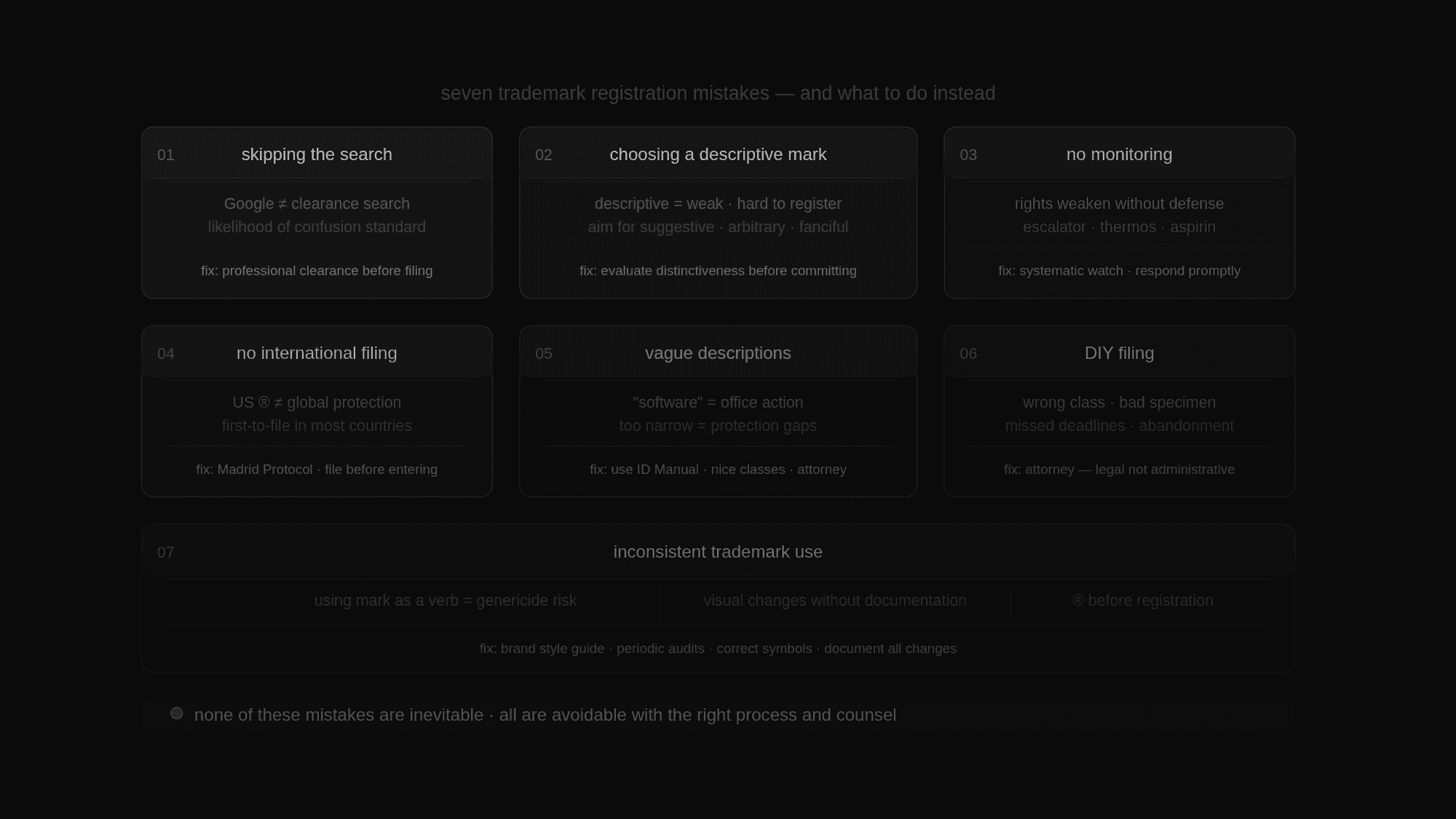
Most trademark registration mistakes are avoidable. They're not the result of bad luck or obscure legal technicalities. They're the result of skipping steps, underestimating the process, or trusting that a quick online search is sufficient due diligence.
The cost of getting it wrong compounds fast. A rejected application means filing fees lost and months of delay. An unenforceable mark means the brand equity you've built has no legal protection behind it. And an infringement dispute that could have been avoided with a proper clearance search can run into six figures before it resolves.
Here are the seven trademark registration mistakes we see most often, and what to do instead.
1. Skipping a comprehensive trademark search
This is the most common and most costly mistake. Before filing any trademark application, you need to know whether a confusingly similar mark already exists. A basic Google search doesn't come close to meeting that standard.
A proper trademark clearance search covers the USPTO's trademark database, state trademark registries, common law sources (unregistered marks that businesses have used in commerce), domain name registrations, and industry-specific databases. The legal standard for infringement is "likelihood of confusion," which is broader than exact matches. A mark that sounds similar, looks similar, or operates in the same commercial space as yours can block registration or expose you to a cease-and-desist.
Skipping this step doesn't save time. It defers the problem to a more expensive stage.
What to do instead: Commission a professional trademark clearance search before you invest in branding, packaging, or marketing around a new name.
2. Choosing a descriptive trademark
The USPTO grades trademarks on a spectrum of distinctiveness, and descriptive marks sit near the bottom. A mark that directly describes what your product or service does, who it serves, or what it contains is very difficult to register and even harder to enforce.
"Fast Delivery Couriers" tells customers exactly what the business does, which is precisely why it fails as a trademark. The law doesn't allow any one company to monopolize a term that competitors need to use to describe their own services.
Businesses often choose descriptive names because they seem helpful to customers. The tradeoff is that these names are legally weak from day one.
The distinctiveness spectrum, from weakest to strongest:
Generic (unregistrable): the common name for the product itself
Descriptive (very difficult to register): describes a feature, quality, or characteristic
Suggestive (registrable): hints at a quality without directly stating it
Arbitrary (strong): a real word applied in an unrelated context
Fanciful (strongest): an invented word with no prior meaning
Aim for suggestive, arbitrary, or fanciful marks. They're easier to register, easier to enforce, and build more durable brand equity over time.
What to do instead: Before committing to a name, have a trademark attorney evaluate where it falls on the distinctiveness spectrum.
3. Neglecting trademark monitoring after registration
Registration is not the finish line. It's the starting point for an ongoing obligation to watch and enforce your rights.
Trademark rights can weaken or disappear if you don't actively defend them. If competitors begin using similar marks and you fail to object, courts may later find that you acquiesced to the infringement. If your mark becomes so widely used as a generic term that consumers no longer associate it with a single source, you can lose the mark entirely. "Escalator," "thermos," and "aspirin" were all once registered trademarks.
Beyond the legal risk, there's the practical reality: infringing listings on e-commerce platforms, copycat social accounts, and similar domain registrations cause real commercial harm every day they go unaddressed.
What to do instead: Set up systematic monitoring for your mark across trademark databases, marketplaces, social media, and domain registrations. When infringement is identified, respond promptly. Early enforcement is almost always cheaper than late enforcement.
4. Ignoring international protection
A US trademark registration protects you in the United States. It does not protect you anywhere else.
This matters more than most founders realize. If your business operates internationally, or plans to, you need trademark protection in each market you care about. In many countries, trademark rights go to the first person to register, not the first to use. That means a competitor or a bad-faith filer can register your mark in a foreign market before you get there, then demand payment to hand it over.
This is not a hypothetical problem. It happens regularly to brands that scale internationally without building IP protection ahead of their expansion.
What to do instead: Identify your key international markets early and file in those jurisdictions before entering them. The Madrid Protocol allows you to file a single international application covering multiple member countries, which significantly reduces cost and administrative complexity compared to filing separately in each country.
5. Using vague or overbroad descriptions of goods and services
Your trademark registration only protects the specific goods and services you identify in your application. Vague or poorly drafted descriptions create two problems: they increase the chance of an office action from the USPTO, and they may leave important parts of your business unprotected even if the application is approved.
"Software" is too broad. "Clothing" is too broad. "Business services" is too broad. USPTO examiners will issue office actions requiring clarification, which delays the application and requires additional attorney time to resolve.
On the other side, descriptions that are too narrow can leave gaps in your protection that competitors exploit. Getting the scope right requires understanding both USPTO requirements and the realistic trajectory of your business.
What to do instead: Work with an attorney to draft descriptions that are specific enough to satisfy USPTO requirements but broad enough to cover where your business is going, not just where it is today. Use the Nice Classification system to identify the correct international classes for your goods and services.
6. Filing the application yourself
DIY trademark filing is one of the most reliable ways to create problems that are more expensive to fix than the attorney fees you were trying to avoid.
The USPTO's online filing system is accessible, but accessibility isn't the same as simplicity. Common errors in self-filed applications include: selecting the wrong trademark class, submitting specimens that don't meet evidentiary requirements, missing deadlines for responding to office actions, and choosing marks that a professional clearance search would have flagged as conflicted.
An abandoned or rejected application doesn't just cost you the filing fee. It costs you the time and, in some cases, it costs you the mark itself if someone else files in the interim.
What to do instead: Treat trademark filing as a legal matter, not an administrative one. The cost of professional representation is small relative to the value of the brand asset you're protecting and the cost of fixing a flawed application later.
7. Using your trademark inconsistently
How you use your trademark in the marketplace affects whether you can enforce it in court. Inconsistent usage creates evidentiary problems and can weaken distinctiveness over time.
Specific issues to watch for:
Using the mark as a verb or noun. Trademark rights depend on the mark functioning as a source identifier, not as a generic term. When a brand becomes a verb ("can you Xerox this?"), it risks becoming generic. Use your trademark as an adjective modifying a generic noun: "BRAND tissues," not "grab a BRAND."
Changing the mark's visual appearance without documentation. If your logo or wordmark evolves over time, you need to maintain a clear record connecting the old and new versions. Otherwise, you may struggle to demonstrate continuous use of the mark in an enforcement proceeding.
Failing to use the correct trademark symbols. Use ™ for unregistered marks and ® only after federal registration is granted. Using ® before registration is a misrepresentation that can affect your rights.
What to do instead: Create a brand style guide that specifies exactly how your trademark should appear, and conduct periodic audits of how it's being used across your website, packaging, advertising, and social media.
Quick-reference checklist
Step | What to do |
|---|---|
Before filing | Commission a professional clearance search across USPTO, state, and common law sources |
Choosing a name | Aim for suggestive, arbitrary, or fanciful marks — avoid descriptive ones |
After registration | Set up monitoring across databases, marketplaces, and social platforms |
International markets | File in key jurisdictions before entering them; consider the Madrid Protocol |
Application drafting | Use specific, accurate descriptions of goods and services in the correct Nice classes |
Filing | Work with a trademark attorney, not a self-filing portal |
Ongoing use | Maintain visual consistency, use correct symbols, and document any changes |
Frequently asked questions
What is the most common reason trademark applications get rejected?
The most frequent grounds for rejection are likelihood of confusion with an existing registered mark, and descriptiveness. Both are avoidable with a proper clearance search and careful mark selection before filing. Procedural issues like vague descriptions and improper specimens are also common causes of office actions, though these are typically correctable with attorney assistance.
How long does trademark registration take in the US?
A straightforward application currently takes roughly 12 to 18 months from filing to registration, assuming no office actions or oppositions. Applications that receive office actions or face third-party oppositions can take significantly longer. Filing on an intent-to-use basis can extend the timeline further, depending on when you achieve actual use in commerce.
Can I trademark a name I've already been using without registration?
Yes. Using a mark in commerce establishes common law trademark rights in the geographic areas where you operate, even without federal registration. However, common law rights are limited in scope and much harder to enforce than federal registration. Federal registration gives you nationwide priority, the right to use the ® symbol, access to federal courts, and the ability to record the mark with US Customs to block infringing imports.
What happens if I don't respond to a USPTO office action?
If you miss the deadline to respond to an office action, your application will be abandoned. You would need to file a new application and pay new filing fees to revive the process. Office action deadlines are firm, which is one of the reasons DIY filing carries real risk — the deadlines don't pause while you figure out how to respond.
How much does trademark registration cost?
USPTO filing fees currently range from $250 to $350 per class of goods or services, depending on the application type. Attorney fees vary by firm and scope of work. At Ana Law, trademark services are offered on a flat-fee basis so you know the total cost upfront.
When should a startup file for trademark registration?
As early as possible, ideally before you launch publicly under the name. Filing on an intent-to-use basis allows you to secure your priority date before you've made a sale. Waiting until after launch exposes you to the risk that someone else files first, or that you've already invested in a brand that turns out to be conflicted.
Trademark registration mistakes are common, but none of them are inevitable. The businesses that avoid them share one habit: they treat trademark protection as a strategic investment, not an administrative checkbox.
If you're ready to file, or want to assess whether your existing marks are as well-protected as they should be, contact Ana Law to schedule a strategy session.