Article
Apr 8, 2026
How to Build an AI Governance Policy for Your Company
Learn how to build an AI governance policy that protects your company legally, manages risk, and sets clear rules for how AI is used across your business.
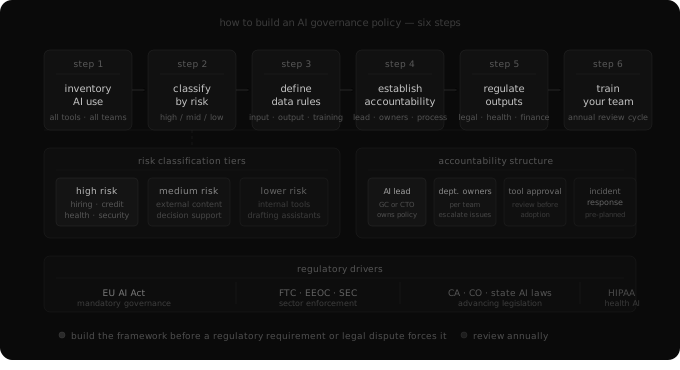
Most companies using AI tools have no written policy governing how those tools are used. Employees are making decisions every day about what data to feed into AI systems, what outputs to rely on, and what to do with the results — without any organizational guidance on the legal, ethical, or operational boundaries of that use.
That gap creates real exposure. Data privacy violations, intellectual property disputes, regulatory non-compliance, and reputational damage are all downstream consequences of AI use that wasn't thought through carefully. And as regulators in the US and abroad move toward mandatory AI governance requirements, companies without existing frameworks will face a much harder compliance path than those that have already built one.
An AI governance policy is not a bureaucratic exercise. It is a practical tool for managing how one of the most powerful and legally complex technologies in your business actually operates. Here is how to build one.
What an AI governance policy is and why it matters
An AI governance policy is a written framework that defines how your company develops, procures, deploys, and uses artificial intelligence. It covers which AI tools are approved for use, what data can be used with those tools, who is responsible for AI-related decisions, and what guardrails apply to AI outputs before they are acted on.
The policy serves several distinct functions. It reduces legal risk by establishing clear rules around data handling, intellectual property, and regulatory compliance. It protects employees by giving them guidance rather than leaving them to make consequential decisions without organizational support. It protects the company in disputes by demonstrating that AI use was governed thoughtfully. And it positions the company for regulatory compliance as AI-specific legislation develops.
The EU AI Act, which began phasing in during 2024, imposes mandatory governance requirements on companies operating in the EU based on the risk level of the AI systems they use. US federal agencies have issued executive orders and guidance documents on AI governance. State-level AI legislation is advancing in California, Colorado, and elsewhere. Companies that already have governance frameworks will adapt to these requirements far more easily than those starting from scratch.
Step 1: Inventory your current AI use
You cannot govern what you have not identified. The first step in building an AI governance policy is a comprehensive inventory of every AI tool your company currently uses or is considering.
This includes obvious tools like large language models used for content generation, but also less visible AI applications: AI-powered hiring and screening tools, customer service chatbots, fraud detection systems, recommendation engines, code generation assistants, and AI features embedded in software products your teams already use.
For each tool, document the following: what the tool does, who uses it and in what context, what data is fed into it, where outputs are used, who the vendor is, and what the vendor's terms of service say about data ownership, training use, and confidentiality.
This inventory frequently produces surprises. Teams adopt AI tools without IT or legal review, data is shared with external platforms without anyone considering what the platform does with it, and vendor terms include provisions that assign rights in ways the company hasn't accounted for. The inventory is where you find these problems before they become costly.
Step 2: Classify your AI use by risk level
Not all AI use carries the same risk, and your governance framework should be proportionate to the risk involved. A useful classification system mirrors the approach taken by the EU AI Act and organizes AI applications into tiers.
High risk applications include AI systems that make or significantly influence decisions affecting individuals: hiring and performance evaluations, credit and financial decisions, medical or health-related decisions, law enforcement or security applications, and systems that process sensitive personal data at scale. These applications require the most rigorous governance: mandatory human review of AI outputs before action is taken, detailed audit trails, bias testing and monitoring, and clear accountability structures.
Medium risk applications include AI tools that generate content used externally, AI systems that inform but do not determine business decisions, and tools that process non-sensitive business data. These require oversight and review processes but not the same level of rigor as high-risk applications.
Lower risk applications include internal productivity tools, drafting assistants used by employees who review and edit outputs before use, and AI tools that assist with research or analysis without driving decisions. These require baseline governance — approved tool lists, data handling rules — but less intensive oversight.
The classification exercise also helps identify applications that should not be deployed at all, at least without significant additional work. AI systems that make consequential decisions without human review, that process data in ways your privacy policy doesn't cover, or that create regulatory exposure you aren't prepared to manage may need to be paused while governance catches up.
Step 3: Define your data rules
Data governance is the core of any AI governance policy because data is where most of the legal exposure lives. Your policy needs to answer the following questions clearly.
What data can employees input into AI tools? Many AI platforms process user inputs to improve their models, store conversation history, or share data with third parties. The default answer for most companies should be: no confidential business information, no personal data of customers or employees, and no data covered by regulatory protections such as HIPAA or attorney-client privilege may be entered into AI tools unless those tools have been specifically reviewed and approved for that data type.
What data can be used to train internal AI models? If your company is building or fine-tuning AI models, the training data rules need to be explicit. This means reviewing the copyright status of training data, ensuring that personal data used for training complies with applicable privacy law, and documenting the provenance of every dataset in your training pipeline.
How are AI outputs handled? Outputs generated by AI tools may carry their own legal implications. Content generated by AI may not be protected by copyright. Code generated by AI assistants may contain elements from copyrighted training data. AI outputs in regulated industries may require specific disclosures. Your policy should specify what review is required before outputs are used, published, or relied on.
Step 4: Establish accountability structures
A governance policy without clear accountability is a document, not a system. Your policy needs to identify who is responsible for what.
An AI governance lead or committee should have overall responsibility for maintaining the policy, reviewing new AI tool requests, and monitoring compliance. In smaller companies this may be a single person, often the General Counsel or CTO. In larger organizations it typically involves a cross-functional committee with legal, technical, compliance, and business representation.
Departmental AI owners should be responsible for governing AI use within their teams, ensuring that approved tools are used within policy guidelines, and escalating novel use cases for review before deployment.
A tool approval process should require that any new AI tool used with company data or for business purposes be reviewed before adoption. The review should cover the vendor's terms of service, data handling practices, security certifications, and whether the tool's intended use falls within your risk classification framework.
An incident response process should specify what happens when something goes wrong: an AI output that causes harm, a data privacy violation involving an AI tool, or a copyright or IP claim related to AI use. Who is notified, what is investigated, and how the incident is documented are all questions your policy should answer in advance.
Step 5: Set rules for AI-generated outputs in regulated contexts
Several industries have specific regulatory requirements that interact directly with AI use, and your governance policy needs to address them explicitly.
Legal and compliance functions involve attorney-client privilege and work product doctrine. AI tools used by legal teams raise questions about whether privilege is waived when confidential information is shared with a third-party platform. Your policy should specify which AI tools, if any, are approved for legal work and what confidentiality protections those tools provide.
Healthcare involves HIPAA protections for protected health information. AI tools that process patient data must comply with HIPAA, which typically requires a Business Associate Agreement with the AI vendor. Many general-purpose AI tools are not HIPAA-compliant and should not be used with patient data.
Financial services involves SEC, FINRA, and other regulatory frameworks that increasingly address AI use in investment advice, trading, and customer communications. AI-generated financial content may be subject to the same disclosure and suitability requirements as human-generated content.
Hiring and employment involves federal and state anti-discrimination law. AI tools used in hiring decisions have drawn significant regulatory attention from the EEOC and state agencies. Your policy should specify what human review is required before any AI-informed hiring decision is made.
Step 6: Train your team and maintain the policy
A governance policy that employees don't know about doesn't govern anything. Training is not optional.
Every employee who uses AI tools should receive training that covers: what tools are approved and for what purposes, what data rules apply, how to identify situations that require escalation, and where to go with questions. The training doesn't need to be lengthy, but it needs to be specific enough to translate the policy into recognizable daily decisions.
The policy itself should be reviewed and updated at least annually. The AI landscape is changing fast enough that a policy written in 2024 may be materially incomplete by 2026. Build a review cycle into the governance structure so that the policy keeps pace with new tools, new regulations, and new use cases your teams are exploring.
Frequently asked questions
Is an AI governance policy legally required?
In the US, there is no single federal law requiring a written AI governance policy for most private companies as of 2026. However, the EU AI Act imposes mandatory governance requirements on companies with EU operations or that serve EU customers, particularly for high-risk AI applications. Several US states are advancing AI legislation with governance requirements. Companies in regulated industries may face sector-specific requirements from the FTC, EEOC, SEC, or HIPAA regulators. Even where not legally required, a governance policy is a meaningful risk management tool and demonstrates good faith in regulatory inquiries and litigation.
How long does it take to build an AI governance policy?
A basic policy for a small or mid-sized company can be developed in four to eight weeks with appropriate legal and technical input. A more comprehensive framework for a larger organization or one with high-risk AI applications will take longer. Starting with a minimum viable policy and building it out over time is a better approach than waiting until the perfect framework is ready.
What is the EU AI Act and does it apply to my company?
The EU AI Act is a comprehensive regulation that classifies AI systems by risk level and imposes requirements accordingly. It applies to companies that place AI systems on the EU market or use AI systems that affect people in the EU, regardless of where the company is headquartered. US companies with EU customers, EU employees, or AI products sold in the EU need to understand their obligations under the Act.
Should our AI governance policy be public?
Some elements of your AI governance framework should be public: your AI use disclosure practices, how AI is used in customer-facing applications, and any relevant regulatory disclosures. The full internal policy does not need to be public, but transparency about how you govern AI use is increasingly expected by customers, investors, and regulators.
Who should own the AI governance policy?
Ownership depends on your company's structure, but cross-functional accountability works better than siloing the policy in a single department. Legal brings regulatory and IP expertise. Technology brings understanding of how the tools actually work. Compliance brings risk management frameworks. Business leadership brings operational context. A policy owned only by IT will miss legal issues; a policy owned only by legal will miss technical realities.
Building an AI governance policy is not about slowing down your use of AI. It is about using AI in a way that holds up — legally, operationally, and reputationally — as the technology and the regulatory environment continue to develop.
Companies that build governance frameworks now will be better positioned than those that wait for a regulatory requirement or a legal dispute to force the issue.
If you want help developing an AI governance policy tailored to your company's risk profile and regulatory environment, contact Ana Law to schedule a strategy session.