Article
Apr 8, 2026
Can AI Be an Inventor? What Patent Law Says and Why It Matters for Your Business
Can AI be an inventor? Learn how patent law treats AI-generated inventions, USPTO rules, and what it means for your intellectual property strategy.
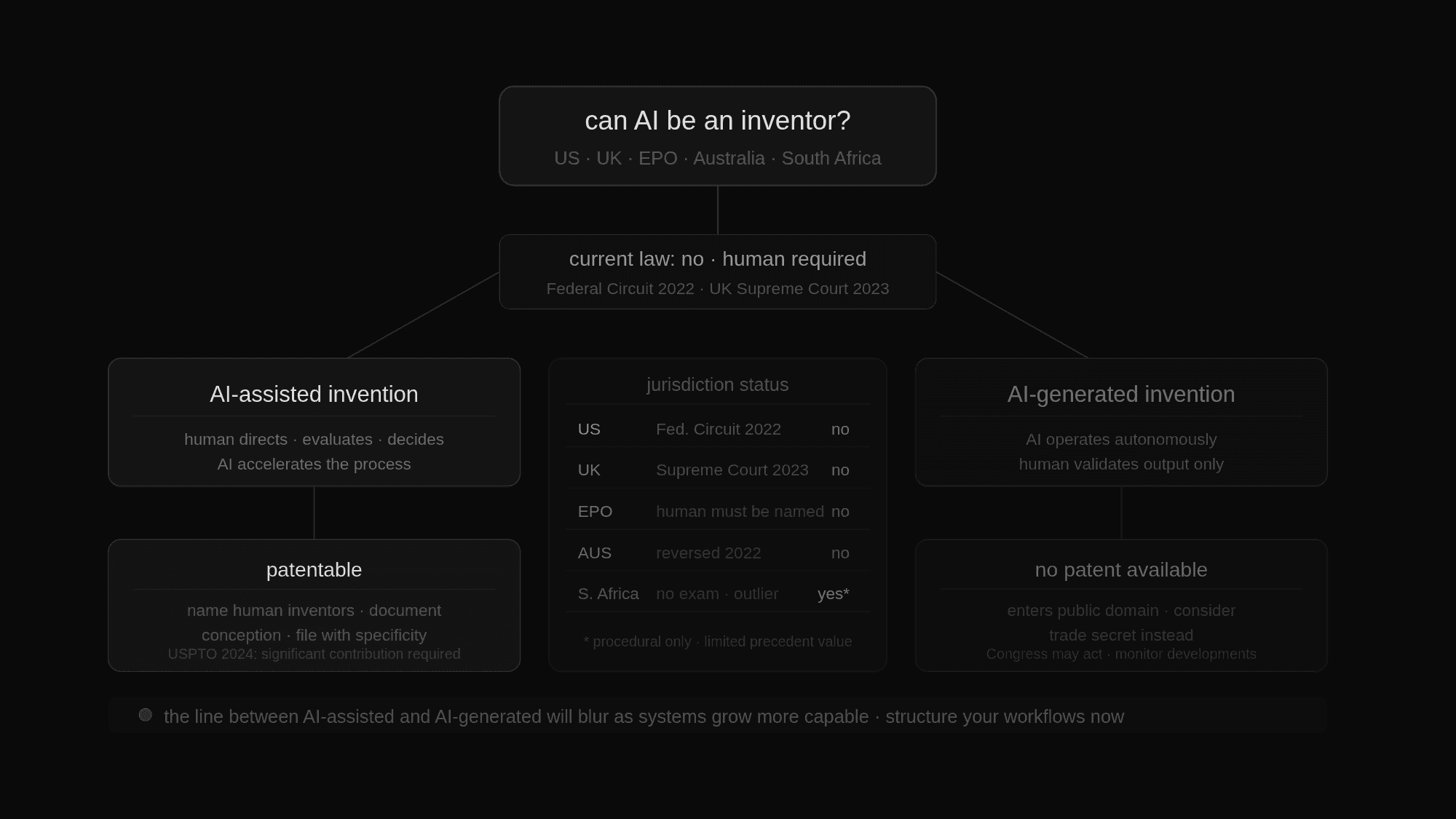
The question sounds almost philosophical: can a machine invent something? But for companies building products with AI, for researchers using machine learning to accelerate discovery, and for attorneys structuring IP strategy around AI-generated outputs, it is one of the most practically consequential questions in patent law right now.
The short answer is no — at least not under current law in the United States and most major jurisdictions. But the longer answer involves a series of court decisions, USPTO guidance documents, international divergence, and an open debate about whether the law needs to change. If your business uses AI as part of its innovation process, understanding where this debate stands and what it means for your patent strategy is not optional.
What the law currently says
The human inventor requirement
US patent law requires inventors to be natural persons. The statute refers to inventors as "individuals," and the USPTO, the Federal Circuit, and the Supreme Court have all interpreted that term to mean human beings. An AI system — regardless of how autonomously it generates a novel output — cannot be named as an inventor on a US patent application.
This is not a gap in the law or an oversight. It is a deliberate feature of a system built on the premise that invention requires human conception: a definite and permanent idea of the complete and operative invention in the mind of the inventor. Conception, as patent law defines it, requires a mind. Under current doctrine, AI systems don't have one.
What counts as conception
The legal standard for inventorship turns on who conceived the invention, not who built it, funded it, or owned the AI system that generated it. Conception means forming a complete mental picture of every element of the claimed invention. An inventor who merely reduces an idea to practice — who builds what someone else conceived — is not the inventor for patent purposes. And an AI system that generates a novel output without human direction of that specific output raises serious questions about whether any human has actually conceived the invention in the legal sense.
This distinction matters enormously in practice. If your R&D team uses AI as a tool — feeding it parameters, evaluating its outputs, and making the key creative decisions — you likely have human inventors whose conception of the invention satisfies the legal standard. If the AI is operating more autonomously, generating outputs that humans then simply validate, the inventorship analysis becomes significantly more complicated.
The DABUS cases: the most important litigation you need to know
The clearest test of AI inventorship doctrine came through a series of cases involving DABUS, an AI system created by Dr. Stephen Thaler. Thaler filed patent applications in multiple countries listing DABUS as the inventor of two inventions: a food container with a fractal surface geometry and a flashing light system for emergency situations. He argued that DABUS autonomously generated both inventions with minimal human direction.
Patent offices and courts around the world rejected the applications on the same ground: the inventor must be a human being.
In the United States, the Federal Circuit affirmed in 2022 that the Patent Act requires inventors to be natural persons. The court's analysis was textualist — "individual" in the statute means a human individual — and explicitly declined to address whether the policy was correct, leaving that to Congress.
In the United Kingdom, the Supreme Court ruled in 2023 that DABUS could not be named as an inventor under UK patent law. The court acknowledged that the law may need to evolve but declined to do so through judicial interpretation.
At the European Patent Office, applications were rejected on the same basis. The EPO has since issued guidance indicating that AI-generated inventions may be patentable if a human inventor who made a significant contribution is named.
The outlier was South Africa, which granted a patent listing DABUS as the inventor. South Africa's patent system does not conduct substantive examination before grant, which means the grant reflects procedural acceptance rather than a considered ruling on the legal question. It has limited persuasive value in jurisdictions with rigorous examination.
Australia presented an interesting detour: the Federal Court initially ruled that AI could be an inventor, but the Full Federal Court reversed that decision in 2022, bringing Australia in line with the US and UK.
The global picture is close to uniform: AI cannot be a named inventor under current law in any major patent jurisdiction.
The distinction that actually matters for your IP strategy
The DABUS cases address an extreme scenario — an AI system operating almost entirely autonomously. Most businesses using AI in innovation are nowhere near that pole. Understanding where your situation falls on the spectrum is what determines your exposure.
AI-assisted invention
In AI-assisted invention, humans set the research goals, design the experiments or queries, evaluate AI outputs, make the creative decisions about which outputs are promising, and determine how to develop them into a complete invention. The AI accelerates and informs the process, but humans are making the conceptual choices.
This is the category that most clearly produces human inventors. The people who conceived the invention — who made the creative leaps — are identifiable and can be named. Patent applications for AI-assisted inventions are being filed and granted every day.
AI-generated invention
In AI-generated invention, the AI system independently produces a novel output with minimal human direction of the specific outcome. Humans may have designed and trained the system, but the specific invention emerged from the AI's autonomous processing rather than from a human's directed conception.
This is the legally problematic category. It's where the DABUS cases live, and it's where the current law creates a gap: if no human conceived the specific invention, there may be no valid inventor to name, and a patent application with no valid inventor cannot be granted.
The honest assessment for most companies: very few AI systems currently operate at the level of autonomy that creates genuine DABUS-style inventorship problems. But as AI systems become more capable, the line between AI-assisted and AI-generated invention will become harder to draw — and the companies that haven't thought about it will face it unprepared.
What the USPTO has said
The USPTO has been more active on AI and IP policy than any other major patent office. In 2020 it issued a report concluding that existing law requires human inventors and that AI-generated inventions without human inventorship cannot be patented. In 2024 it issued guidance specifically addressing inventorship for AI-assisted inventions.
The core of the 2024 guidance: a person who uses an AI system is not automatically an inventor. To qualify as an inventor, a human must have made a significant contribution to the conception of at least one claim. Merely owning the AI system, running the prompts, or recognizing that an AI output is valuable does not make someone an inventor. The human contribution must be substantive and directed at the claimed invention itself.
This guidance matters for patent prosecution strategy. If you are filing patents for AI-assisted inventions, you need to be able to articulate — with specificity — what each named inventor conceived and how that conception contributed to the specific claims being filed. Vague or reflexive inventorship designations are increasingly a target for invalidity challenges.
What this means for companies building with AI
Audit your inventorship practices now
If your company has been filing patents for AI-assisted inventions without carefully analyzing the human contribution to each claim, you have potential invalidity exposure. Patents granted with incorrect inventorship can be challenged and invalidated. The standard for a successful inequitable conduct defense has evolved, but inventorship errors remain a genuine litigation risk.
Document human contributions throughout the development process
For every invention where AI played a role, maintain contemporaneous records of what decisions humans made, when they made them, and how those decisions shaped the final invention. Lab notebooks, version histories, internal communications, and meeting records all help establish the timeline of human conception. This documentation becomes your evidence if inventorship is ever challenged.
Structure your AI workflows to preserve human inventorship
The way your team interacts with AI systems during R&D affects your patent rights. Teams that define the problem, design the experimental framework, evaluate outputs against specific criteria, and make creative decisions about which directions to pursue are generating clear human inventors. Teams that simply prompt an AI and accept its outputs are creating inventorship ambiguity.
This is not an argument against using AI in R&D — it is an argument for using it thoughtfully, with an eye toward what your patent strategy requires.
Watch for legislative and regulatory developments
The Federal Circuit's DABUS decision explicitly noted that any change to the human inventor requirement is a matter for Congress, not the courts. Several proposals have been floated — including new categories for AI-assisted inventions and benefit-sharing models that distribute rights among AI developers, system operators, and data providers — but none has passed. The USPTO continues to study the issue and may issue additional guidance. This is an area where the law is actively developing, and companies with significant AI-related IP should be monitoring it.
Frequently asked questions
If my company owns the AI system that generated an invention, does it own the patent?
Not automatically. A company can own a patent through assignment from human inventors, but there must be valid human inventors to assign from. If no human conceived the invention in the legal sense, there is no valid inventor, and a patent application would lack the required inventorship disclosure. Ownership of the AI system does not substitute for valid inventorship.
Can I name the AI developer as the inventor for AI-generated inventions?
Only if the developer actually conceived the claimed invention — not merely because they built or trained the system. Training a general-purpose AI system does not make the trainer an inventor of every output the system later produces. The inventorship analysis focuses on the specific invention claimed, not on who built the tool that generated it.
What happens to AI-generated inventions that have no human inventor?
Under current law, they cannot be patented in the US or most major jurisdictions. They may fall into the public domain, available for anyone to use. This is one of the strongest arguments made by proponents of AI inventorship reform: without patent protection, companies may have less incentive to disclose AI-generated innovations, undermining the disclosure function of the patent system.
How is the EU approaching AI inventorship?
The EPO requires human inventors but has indicated that AI-assisted inventions are patentable when a human who made a significant contribution is named. The EU is actively studying AI and IP policy, and the European Commission has published reports on the topic, but no major legislative change has been enacted.
Does trade secret protection work better than patents for AI-generated inventions?
For some companies, yes. Trade secret protection doesn't require disclosure, doesn't depend on inventorship, and can protect both the AI system itself and its outputs indefinitely as long as reasonable steps are taken to maintain secrecy. The tradeoff is that trade secret protection is lost if the information becomes public through reverse engineering or independent discovery. The right answer depends on the specific invention, the competitive landscape, and how the company plans to commercialize the technology.
The question of whether AI can be an inventor will not be resolved quickly. The courts have said no under current law, Congress has not acted, and the USPTO is navigating the gap with guidance rather than rulemaking. What is clear is that companies building on AI-generated innovation need to think carefully about their IP strategy now — before an invalidity challenge or a competitor's filing makes the question urgent.
If you want to evaluate your AI-related patent portfolio or structure your R&D workflows to protect your IP, contact Ana Law to schedule a strategy session.