Article
Apr 8, 2026
Delaware vs. Wyoming LLC: Which Entity Is Right for Your Startup
Choosing between a Delaware and Wyoming LLC affects your taxes, investor readiness, and legal protections. Here is what founders need to know before they file.
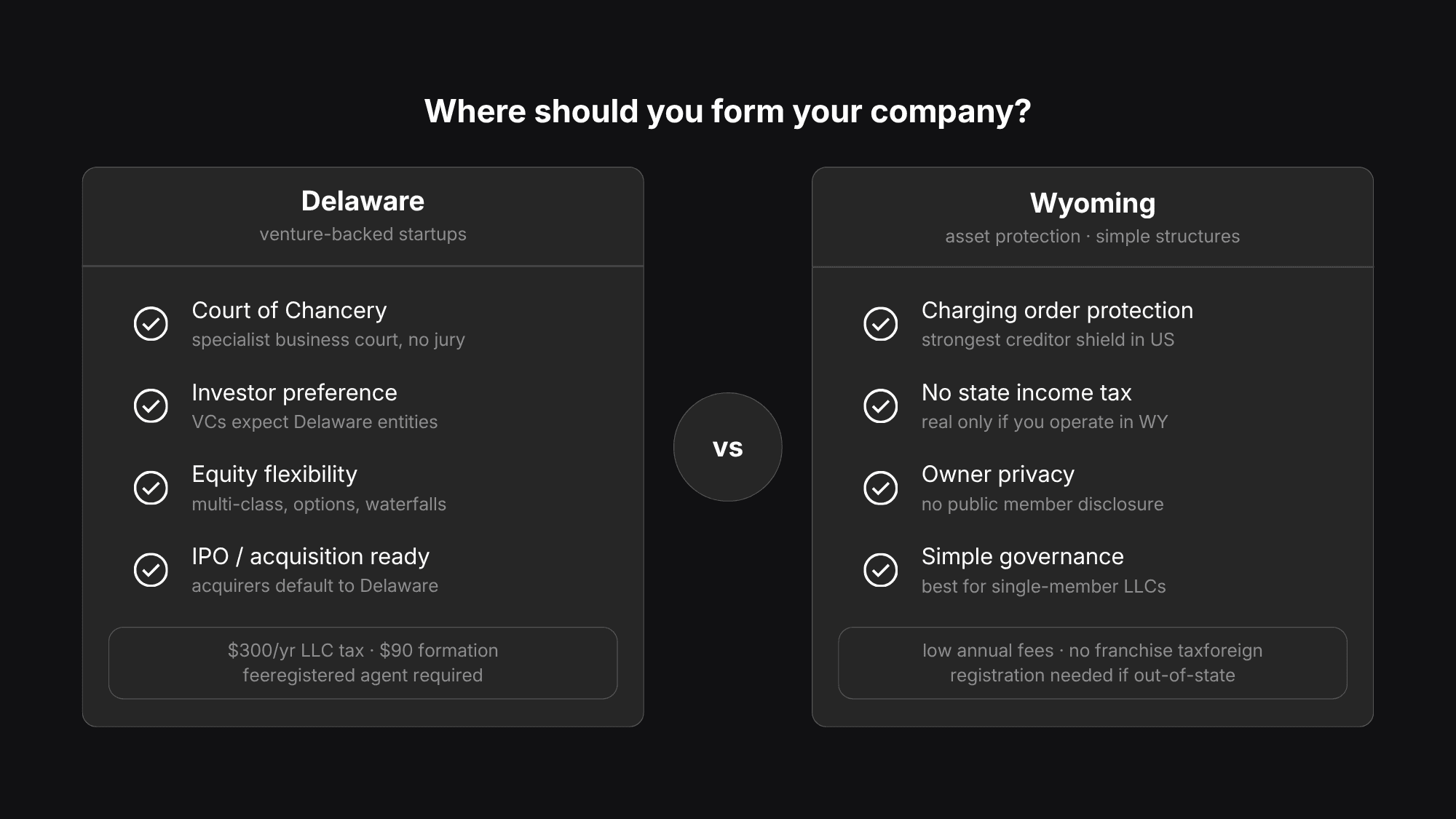
One of the first legal decisions every founder makes is where to form their company. Most articles on this topic treat it as a simple choice: Delaware for startups raising venture capital, Wyoming for everything else. The reality is more nuanced, and getting it wrong has consequences that compound over time — in taxes, investor relationships, governance flexibility, and legal protection.
This post covers what actually matters in the Delaware versus Wyoming decision, what each state's legal framework offers, and how to think about the choice based on where your company is headed.
Why the state of formation matters
When you form an LLC, you are choosing which state's laws govern your company's internal operations, member rights, manager authority, and dispute resolution. This is true regardless of where you actually do business. A Wyoming LLC operating entirely in California is still governed by Wyoming LLC law for its internal affairs, even though it will need to register as a foreign entity in California and pay California taxes on its California income.
The state of formation also determines which courts have jurisdiction over internal disputes. Delaware disputes go to the Delaware Court of Chancery. Wyoming disputes go to Wyoming state courts. This matters more than most founders realize, particularly when investor or co-founder relationships break down.
Formation state does not determine where you pay taxes on business income. You pay state income taxes where you have economic activity, regardless of where you are formed. A Wyoming LLC with operations in New York pays New York taxes on New York income. Formation state determines governance law, not tax geography.
The case for Delaware
Delaware is the dominant choice for venture-backed startups, and the reasons are substantive rather than merely conventional.
The Court of Chancery
Delaware's Court of Chancery is a specialized business court with no jury, judges who are experts in corporate and LLC law, and a decades-long body of precedent covering nearly every governance situation a company might face. When a dispute arises between founders, between a company and its investors, or in connection with a merger or acquisition, Delaware courts can resolve it quickly and predictably based on well-developed case law.
For founders and investors alike, this predictability has real value. If your cap table, governance documents, and equity agreements are structured under Delaware law, everyone in the deal knows what the rules are. Delaware precedent is extensive enough that lawyers can give confident advice about how courts will handle novel situations because courts have already handled analogous ones.
Investor and acquirer preference
Institutional venture capital funds, corporate venture arms, and most strategic acquirers strongly prefer Delaware entities. This preference is so established that some funds will not invest in a company formed in another state without requiring it to reincorporate in Delaware first. The cost of reincorporation, both in legal fees and in potential tax consequences, is a meaningful downside to starting in a non-Delaware jurisdiction if you expect to raise institutional capital.
If your startup has any realistic path toward venture funding, a Series A, or an institutional growth round, forming in Delaware from the start is almost always the right decision. The administrative cost of a Delaware formation is not significant enough to justify the friction of a later reincorporation.
Flexible governance for equity structures
Delaware LLC law and corporate law offer the most flexible frameworks for complex equity structures: multiple classes of membership interests, preferred return waterfalls, investor consent rights, drag-along and tag-along provisions, and conversion mechanics. These structures are routine in venture-backed companies and are well-supported by Delaware law and by the transactional attorneys who work with Delaware entities every day.
The ecosystem around Delaware entities, including attorneys, accountants, and institutional service providers, is also the most developed of any state. Form documents, standard term sheets, and market practice have all been built around Delaware law. Deviating from that ecosystem creates friction that has real costs in transaction speed and legal fees.
The Delaware franchise tax reality
Delaware does impose a franchise tax on corporations, and for high-authorized-share structures it can be significant. The franchise tax is often cited as a disadvantage of Delaware, but it is worth contextualizing. For LLCs, Delaware imposes a flat annual fee of $300 regardless of size or revenue, which is not a meaningful burden. The franchise tax concern applies primarily to Delaware corporations with large authorized share counts, not to Delaware LLCs. Most venture-backed companies are formed as corporations rather than LLCs, which is a separate decision from the state of formation question.
The case for Wyoming
Wyoming has positioned itself aggressively as a business-friendly formation state, and its LLC statute has genuine advantages for certain types of businesses and founders.
Charging order protection
Wyoming offers some of the strongest charging order protection of any state. A charging order is the exclusive remedy a judgment creditor of an LLC member can obtain against the member's interest in the LLC. In many states, a creditor who obtains a judgment against you personally can foreclose on your LLC membership interest and step into your shoes as a member. Wyoming law specifically limits creditors to charging orders and prohibits foreclosure on membership interests in most cases, providing meaningful asset protection for founders and operators with personal liability exposure.
For businesses in industries with higher litigation risk, for founders who have personal assets they want to protect, or for holding company structures where asset protection is a primary goal, Wyoming's charging order protection is a real advantage.
No state income tax and low fees
Wyoming has no state income tax, no franchise tax on LLCs, and low annual filing fees. For businesses with significant Wyoming nexus or for founders who are themselves Wyoming residents, this creates a genuine tax advantage. However, as noted above, the formation state does not determine where you pay income taxes on business activity. If your business operates in California, New York, or any other high-tax state, you will pay taxes in those states on that income regardless of where your LLC is formed.
The tax advantage of a Wyoming formation is real for businesses that actually operate in Wyoming or for founders who are Wyoming residents. It is largely illusory for founders who live and operate in high-tax states and are forming in Wyoming for tax reasons, because the tax obligation follows the economic activity, not the registration.
Privacy
Wyoming does not require the names of LLC members or managers to be disclosed in public filings. This provides a meaningful level of privacy for business owners who have legitimate reasons to keep their ownership of a company confidential. Delaware also offers reasonable privacy protections, but Wyoming's are more extensive.
For real estate holding companies, investment vehicles, and businesses where owner privacy is a priority, Wyoming's privacy protections are a genuine advantage.
Simpler governance for single-member and small businesses
Wyoming's LLC statute is flexible and straightforward, making it a good fit for single-member LLCs, family businesses, and businesses that do not need complex multi-class equity structures. If you are forming a simple business without outside investors, without complex governance needs, and without plans for institutional fundraising, Wyoming's simplicity can be an advantage over Delaware's more elaborate framework.
The comparison that actually matters: your specific situation
The Delaware versus Wyoming decision should be driven by where your company is going, not by default or by the cheapest filing option.
Form in Delaware if:
You are planning to raise venture capital, angel investment, or any form of institutional equity financing. Investors expect Delaware entities, and starting elsewhere creates friction and potential reincorporation costs. You expect to bring on co-founders, employees with equity, or advisors with equity compensation. Complex equity structures, vesting schedules, and option pools are best handled under Delaware law. You are building toward an acquisition or IPO. Acquirers and underwriters work in Delaware by default, and a non-Delaware entity complicates the process. You want access to the most developed body of business case law and the most predictable governance framework available.
Form in Wyoming if:
You are building a business that will not raise institutional equity and does not need complex governance. A sole proprietor, a family business, a real estate holding company, or a professional services practice that will be funded by revenue rather than investors. You are a Wyoming resident and the business will genuinely operate in Wyoming. In this case, the tax and fee advantages are real rather than illusory. Asset protection is a primary concern and you are structuring a holding company or investment vehicle where Wyoming's charging order protection provides meaningful benefit. Privacy is a genuine operational priority for your business structure.
The foreign qualification reality
Wherever you form, if you operate in another state, you need to register as a foreign entity in that state and comply with its tax and regulatory requirements. A Wyoming LLC operating in California is subject to California's $800 minimum franchise tax, California's LLC fee based on gross receipts, and California's regulatory requirements, all in addition to Wyoming's annual fee.
This is the calculation that founders often miss when they form in a low-tax state for perceived tax benefits. The savings from Wyoming's low fees are often offset or exceeded by the foreign registration costs and compliance obligations in the state where the business actually operates. Do the full math before choosing a formation state for tax reasons.
Frequently asked questions
Can I change my formation state later if I choose wrong?
Yes, through a process called domestication or conversion, which moves the entity from one state to another without dissolving and reforming it. Delaware allows domestication into Delaware from most other states. The process involves legal fees, filing fees, and potentially state tax consequences. It is not prohibitively expensive, but it is a transaction that could have been avoided by forming in the right state initially.
Do I need a registered agent in my formation state?
Yes. Both Delaware and Wyoming require LLC formed in those states to maintain a registered agent with a physical address in the state. Registered agent services are available in both states for annual fees typically ranging from $50 to $300. This is a minor but ongoing administrative and cost consideration.
Is a Delaware LLC or a Delaware corporation better for a venture-backed startup?
Most institutional investors prefer Delaware C corporations over LLCs for venture-backed companies. The reasons involve tax treatment of investors, the ability to issue stock options under standard equity plans, and the well-developed case law around corporate governance. LLCs are more flexible in some respects but less compatible with standard venture investment structures. If you are planning to raise institutional venture capital, a Delaware C corporation is typically the right structure. If you are raising from angels or revenue-based investors, or if you have specific tax reasons to prefer pass-through taxation, a Delaware LLC may be appropriate.
What does it actually cost to form and maintain a Delaware LLC?
Delaware LLC formation costs include the state filing fee (currently $90 for a Certificate of Formation), a registered agent fee (typically $50 to $200 per year), and the annual $300 LLC tax. Total first-year costs including legal fees for a simple operating agreement typically range from $500 to $2,000 depending on complexity. This is not a significant expense relative to the governance and investor-readiness advantages Delaware provides.
Should I form my LLC myself or use an attorney?
For a simple single-member LLC with no outside investors and no complex governance needs, self-filing is feasible using the state's online filing system. For any LLC with multiple members, outside investors, equity compensation plans, or complex governance, attorney involvement in drafting the operating agreement is worth the cost. The operating agreement governs the relationship between members, and a poorly drafted one creates disputes that cost far more to resolve than the attorney fees would have cost upfront.
The Delaware versus Wyoming decision is less about which state is objectively better and more about which state's legal framework fits where your company is going. For most startups with growth ambitions, institutional fundraising plans, or complex equity needs, Delaware is the right answer. For simpler businesses, holding structures, or founders with specific asset protection or privacy priorities, Wyoming has genuine advantages.
Getting the formation decision right from the start is one of the easiest ways to avoid costly restructuring later. If you want help thinking through the right entity structure for your business, contact Ana Law to schedule a strategy session.