Article
Apr 8, 2026
What Is a Founder Vesting Schedule and Why It Matters for IP Ownership
A founder vesting schedule protects your startup from early departures and keeps IP ownership clean for investors. Learn how vesting works and why it matters before you raise.
When two or three founders start a company together, equity is usually divided based on who is contributing what right now. One founder gets 50 percent, another gets 30 percent, a third gets 20 percent. Everyone shakes hands, the cap table is set, and the company moves forward.
Six months later, one founder leaves. They had a different vision for the product. They got a better job offer. The relationship broke down. It happens more often than founders expect, and without the right structure in place, it creates a problem that can follow the company for years: a departed founder who contributed relatively little still owns a significant chunk of equity, sits on the cap table as a ghost, and may hold IP that was never properly transferred to the company.
A founder vesting schedule is the structure that prevents this. It is also, less obviously, one of the most important mechanisms for keeping IP ownership clean — which matters directly to every investor who will ever look at your company.
What a founder vesting schedule is
A vesting schedule is a timeline over which a founder earns their equity in the company. Rather than receiving all of their shares immediately upon incorporation, a founder receives shares that become fully owned over time based on continued involvement with the company.
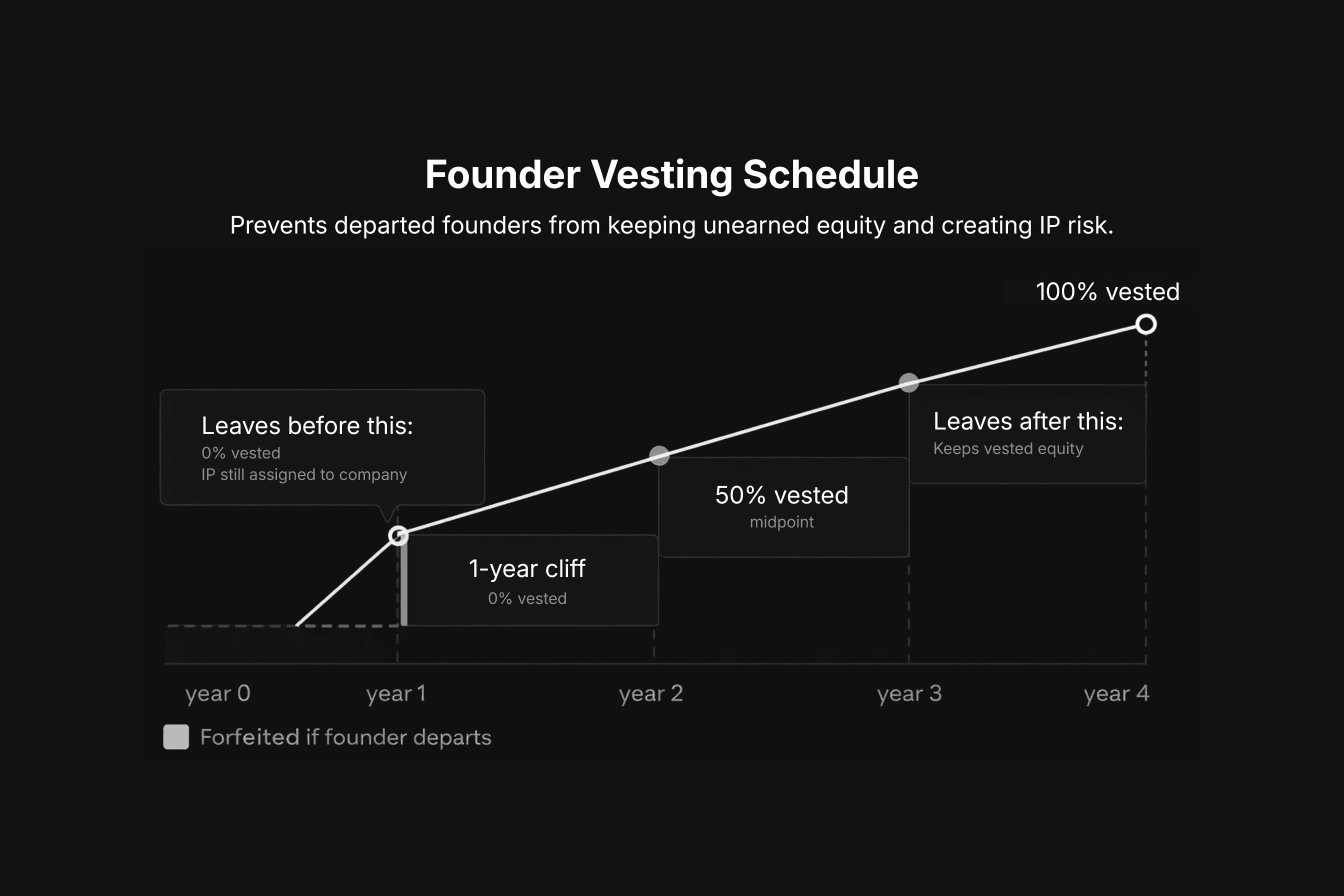
The most common structure in venture-backed startups is a four-year vesting schedule with a one-year cliff. Under this structure, no equity vests during the first year. At the end of year one, 25 percent of the founder's total equity vests all at once. The remaining 75 percent vests monthly or quarterly over the following three years. If a founder leaves before the one-year cliff, they receive no vested equity. If they leave after two years, they keep approximately 50 percent of their total grant and forfeit the rest.
The cliff serves as a commitment mechanism. It ensures that a founder who leaves very early, before they have made a meaningful long-term contribution, does not walk away with a large equity stake that dilutes everyone else and sits inactively on the cap table.
Vesting schedules are implemented through restricted stock agreements, not through the cap table allocation itself. The cap table shows total shares issued. The restricted stock agreement defines what happens to those shares if the founder leaves before they are fully vested. Unvested shares are typically subject to repurchase by the company at the original issuance price, which is usually nominal for early-stage companies.
Why vesting schedules matter for IP ownership
The connection between vesting and IP ownership is not obvious at first, but it is important and investors understand it well.
When a founder's equity vests, it signals that the founder has remained committed to the company and continued to contribute to its development. When a founder leaves before vesting and forfeits their equity, the company has the right to repurchase their shares. This repurchase right is one half of the protection. The other half, which is equally important and more directly IP-related, is what happens to the work the departed founder contributed.
If a departing founder signed an IP assignment agreement, the technology they contributed belongs to the company regardless of whether their equity vests. The vesting schedule and the IP assignment operate independently. But in practice, the two are related in ways that matter.
Founders who leave before vesting are more likely to dispute IP ownership. A founder who forfeits significant equity on departure has an economic incentive to assert that the technology they contributed belongs to them rather than the company. Without a signed IP assignment agreement, that assertion may have legal merit. With one, the company owns the technology regardless of the equity dispute. This is why IP assignment agreements need to be in place before any work begins, not added later when a founder is threatening to leave.
Investors look at vesting as a proxy for governance health. When a Series A investor reviews a company's cap table and sees that all founders have fully vested equity, it is a neutral data point. When they see that a co-founder who left eighteen months ago owns 30 percent of the company with no vesting, it is a significant red flag. That departed founder has no obligation to the company, no ongoing contribution, and potentially relationships with competitors. The equity stake is a governance problem, a dilution problem, and depending on how the IP assignment was handled, potentially an IP problem.
Unvested equity and IP are the combination that kills deals. The worst-case scenario in due diligence is a departed founder who owns significant unvested equity and who never signed an IP assignment agreement. In this scenario, the company may not own the technology the departed founder contributed, and the departed founder has leverage to extract value from the company's success despite not having stayed to build it. This scenario plays out in real deals and it is entirely preventable.
How vesting interacts with different types of equity
Founder vesting most commonly applies to common stock issued to founders at incorporation. It can also apply in slightly different forms to other equity instruments.
Restricted Stock Awards (RSAs) are the most common structure for founder equity. The founder receives shares at the time of grant, subject to the company's right to repurchase unvested shares at cost if the founder leaves. An 83(b) election filed with the IRS within 30 days of the grant allows the founder to pay taxes on the full value of the grant at the time of issuance rather than as shares vest, which typically results in significantly lower taxes for startups whose equity value increases over time.
Stock options vest rather than being subject to repurchase. An unvested option simply cannot be exercised. Options are more commonly used for employees than for founders, but some early-stage companies use them for all equity grants. The vesting mechanics are the same; the tax treatment is different.
Profits interests in LLCs vest similarly to equity in corporations and raise the same IP and governance considerations. The specific mechanics depend on the operating agreement.
The 83(b) election and why it matters
The 83(b) election is not directly an IP issue, but it is closely related to founder vesting and is worth understanding because missing it has significant financial consequences.
When a founder receives restricted stock that vests over time, the IRS treats each vesting event as a taxable event. As the stock vests, the founder recognizes ordinary income equal to the fair market value of the vesting shares at the time of vesting. If the company has grown significantly in value by the time shares vest, the tax bill can be substantial.
An 83(b) election allows the founder to treat the entire grant as a taxable event at issuance rather than as shares vest. At the time of issuance, the stock is typically worth very little, so the tax is minimal. The founder then pays capital gains tax rather than ordinary income tax when the stock is eventually sold, assuming they hold it long enough to qualify for long-term capital gains treatment.
The election must be filed with the IRS within 30 days of the grant. Missing the 30-day window is irreversible and can cost founders significant money. This is one of the most time-sensitive legal steps in a startup's early life, and it is one that should be flagged to every founder at the time their equity is granted.
What happens when founders do not have vesting schedules
The absence of a vesting schedule is one of the more common findings in pre-Series A due diligence, particularly for companies that were bootstrapped for a year or more before raising. Founders who were not advised by startup counsel, who copied documents from the internet, or who simply did not prioritize the governance structure early on frequently end up without vesting agreements.
The consequences depend on the specific facts, but common outcomes include:
A departed founder owns a large percentage of the company. Without vesting, there is no repurchase right. The departed founder owns their shares outright and there is no mechanism to reclaim them. This creates a cap table problem that investors find unattractive and that complicates future financing and acquisition conversations.
Investors require a vesting retrofit. Some investors will condition their investment on existing founders agreeing to a new vesting schedule applied to some or all of their equity. This is an uncomfortable conversation that founders could have avoided by implementing vesting at founding. Asking an active founder to agree to a new four-year vest when they have already been working on the company for two years is a negotiation that creates friction and sometimes resentment.
Acquisition becomes complicated. Acquirers use vesting as a retention mechanism. When they acquire a company, they typically want founders and key employees to have unvested equity that converts to acquirer equity, creating an incentive to stay through the integration period. Founders with fully vested equity at the time of acquisition have less incentive to stay, and acquirers will negotiate accordingly. Implementing vesting at founding, and having it still running at the time of acquisition, is a better position than arriving at a deal fully vested with no retention hook.
Best practices for founder vesting schedules
Implement vesting at incorporation. Do not wait until you are raising or until a co-founder situation becomes complicated. The easiest time to implement vesting is before any equity has been issued and before any of the founders have contributed significant work. Everyone agrees in principle to vesting before there is any real value at stake.
Use a four-year schedule with a one-year cliff as the starting point. This is the market standard for a reason. It aligns founder incentives with investor expectations and creates a defensible structure in due diligence. Variations exist and may be appropriate in specific circumstances, but deviating from the standard requires a clear rationale.
File 83(b) elections within 30 days. For every founder who receives restricted stock, the 83(b) election should be filed within 30 days of the grant. Set a calendar reminder the day equity is issued and treat this deadline as non-negotiable.
Pair vesting with IP assignment agreements. The vesting schedule protects the equity structure. The IP assignment agreement protects the technology. Both need to be in place, and neither substitutes for the other. A founder who is subject to vesting but never signed an IP assignment has protected the cap table without protecting the IP. Both documents should be executed simultaneously at or before incorporation.
Account for acceleration provisions. Some founder agreements include acceleration provisions that cause unvested equity to vest faster in certain triggering events, most commonly an acquisition. Single-trigger acceleration (vesting accelerates on acquisition alone) is less favorable to acquirers. Double-trigger acceleration (vesting accelerates if the founder is terminated without cause following an acquisition) is more commonly acceptable. The acceleration provisions are a negotiating point with investors and acquirers and should be drafted thoughtfully.
Frequently asked questions
Can founders negotiate their vesting schedule with investors?
Yes, within limits. Some investors will accept modified vesting schedules for founders who have been working on the company for an extended period before the investment, giving them credit for time already served. This is called a vesting credit or a vesting reset with partial credit. The specifics depend on the investor and how long the founders have been at it. The further you are from the standard four-year cliff schedule, the more explanation investors will expect.
What happens to unvested equity if the company is acquired before the vesting schedule is complete?
It depends on the acquisition agreement and the founder's vesting provisions. In many acquisitions, unvested founder equity is assumed by the acquirer and converts to unvested acquirer equity under a new vesting schedule, creating retention incentive. In some acquisitions, unvested equity is cancelled and replaced with new grants. Double-trigger acceleration provisions, if in place, can cause unvested equity to vest if the founder is terminated without cause following the acquisition.
Do vesting schedules apply to solo founders?
Technically, a solo founder has no co-founder equity issues to protect against, and some solo founders choose not to implement vesting. However, investors will typically require a vesting schedule before investing regardless, because unvested equity creates the retention hook that makes the founder more likely to stay through challenges. A solo founder who agrees to a vesting schedule at the time of investment is in a better position than one who negotiates it during the term sheet.
What is the difference between a vesting schedule and an option pool?
A vesting schedule governs when already-granted equity is earned. An option pool is a reserve of shares set aside for future grants to employees, advisors, and consultants. They are related but distinct. Founders typically receive restricted stock subject to vesting schedules. Employees typically receive options that vest over time. Both are components of the equity structure that investors will review in due diligence.
What if a co-founder contributed IP before we implemented vesting?
The IP contribution and the vesting schedule are separate issues. The IP is addressed through an IP assignment agreement, which should be executed regardless of when vesting is implemented. The vesting schedule addresses future equity earnings, not past contributions. If a co-founder contributed significant IP before vesting was in place, the IP assignment is the mechanism that transfers that contribution to the company, and it should be executed as soon as possible regardless of the vesting status.
A founder vesting schedule is not just an equity mechanism. It is a governance structure that protects the company from the most common and most damaging early-stage failure mode: a founder who leaves before building sufficient value, takes their equity with them, and creates a cap table and IP problem that follows the company through every future financing and acquisition conversation.
Implementing vesting at founding, pairing it with IP assignment agreements, and filing 83(b) elections on time are three of the highest-leverage legal steps a startup can take in its first 30 days. If you want help structuring your founding documents correctly from the start, contact Ana Law to schedule a strategy session.