Article
Apr 6, 2026
How to Renew a Trademark: Deadlines, Documents, and What Not to Miss in 2026
Learn how to renew a trademark, including USPTO deadlines, required documents, and common mistakes to avoid. This guide covers trademark renewal timelines, declaration of use requirements, and how to keep your registration active.
A trademark registration doesn't protect itself. Once you've secured your mark, the USPTO requires you to come back and prove you're still using it — on a specific schedule, with specific documentation, and with filing fees that go up if you miss the window.
Most trademark owners know renewal exists. Fewer understand exactly when it's due, what's required, or what happens if they get it wrong. This guide covers all of it.
Why trademark renewal matters
A lapsed trademark doesn't just create an administrative problem. It creates a legal one.
When a trademark registration is cancelled for failure to renew, you lose the exclusive rights that registration provides: the right to use the ® symbol, the presumption of ownership nationwide, and the ability to record your mark with US Customs to stop infringing imports. Competitors can begin using your mark freely. In the worst cases, someone else can register it themselves — and you'd be the one who has to rebrand.
The value you've built into your brand depends on that registration staying active. Renewal is how you keep it that way.
Trademark renewal deadlines: the full timeline
The USPTO has two distinct renewal windows, and missing either one puts your registration at risk.
Between year 5 and year 6: the Section 8 declaration
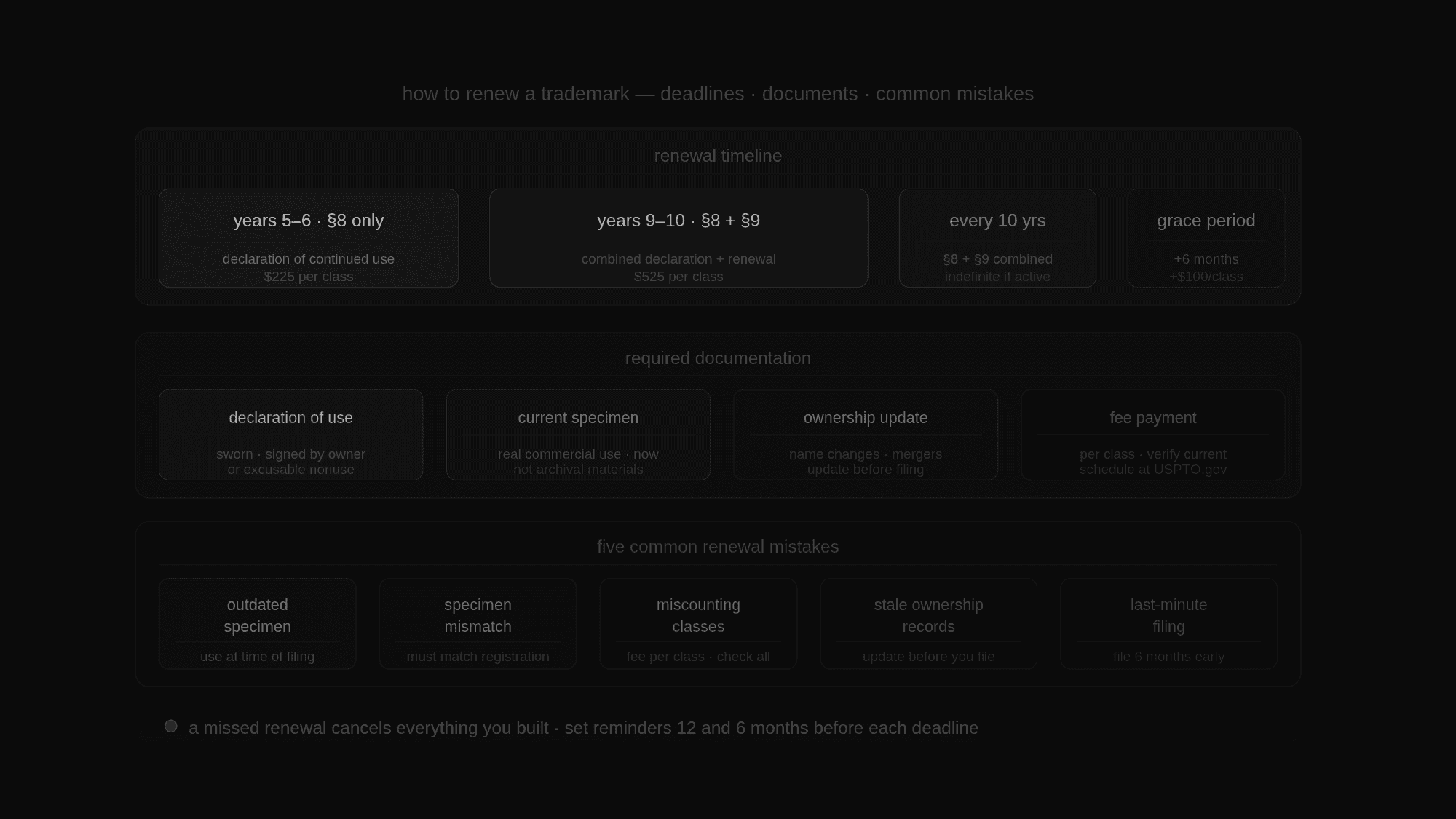
The first filing is due between the 5th and 6th year after your registration date. This is called a Section 8 Declaration of Continued Use (or Excusable Nonuse). Its purpose is to confirm to the USPTO that your mark is still actively being used in commerce.
This filing is not optional and it is not combined with a full renewal — it stands alone. If you miss the year 5-6 window, your registration will be cancelled.
Between year 9 and year 10: the combined Section 8 and Section 9
The second filing is due between the 9th and 10th year after registration. This one combines a Declaration of Continued Use (Section 8) with a formal renewal application (Section 9). After this point, renewals are due every 10 years on the same schedule.
The grace period
Both windows come with a six-month grace period after the deadline. You can still file during this period, but the USPTO charges an additional $100 per class on top of standard renewal fees. More importantly, relying on the grace period introduces unnecessary risk. Rushed filings produce errors, and if you miss the grace period entirely, your registration is gone.
The grace period is a safety net. It should not be your plan.
What you need to file
Regardless of which renewal window you're in, the core documentation is the same.
Declaration of continued use or excusable nonuse
This is a sworn statement confirming that your trademark is currently in use in commerce for the goods and services listed in your registration. If you've temporarily stopped using the mark for legitimate reasons (illness, supply chain disruption, a pivot in business model), you can file a declaration of excusable nonuse instead — but you'll need to explain why use stopped and when you intend to resume it.
Specimens showing current use in commerce
You must submit evidence of your mark being used in real commercial activity at the time of filing — not old materials, not mock-ups, not internal documents.
For goods, acceptable specimens include product labels, product packaging, and screenshots of online listings showing the mark associated with the product and a mechanism to purchase it.
For services, acceptable specimens include advertisements, website screenshots showing the mark used in connection with the service, and brochures or marketing materials.
The USPTO has tightened its review of specimens in recent years. Submitting a stock image with your logo dropped on it, or a specimen that doesn't match the registered description of goods and services, will draw an office action and delay your renewal.
Updated ownership information
If anything about your ownership has changed since registration — a name change, a merger, an acquisition, or an assignment of the mark — that needs to be reflected in your renewal filing. Discrepancies between your registration record and your actual ownership can create serious problems in enforcement proceedings down the line.
Renewal fees
As of 2026, the USPTO fee for a combined Section 8 and Section 9 renewal is $525 per class of goods or services. The Section 8-only declaration (for the year 5-6 filing) is $225 per class. Late filings during the grace period add $100 per class on top of those amounts. Always verify current fees on the USPTO website before filing, as the fee schedule updates periodically.
Common renewal mistakes
These are the errors that cause otherwise straightforward renewals to fail.
Submitting outdated specimens. The specimen must show current use, meaning use at or near the time of filing. Pulling packaging from three years ago, or screenshots from an archived version of your website, will not satisfy the requirement.
Mismatching specimens to registered goods and services. If your registration covers "online retail store services featuring athletic apparel" and your specimen shows a product label, that's a mismatch. Every specimen needs to correspond directly to what's listed in your registration.
Miscounting classes. Renewal fees are calculated per class of goods or services. If your registration covers multiple classes and you only pay for one, your filing is incomplete. Check your registration carefully before calculating fees.
Failing to update ownership records. If your company underwent a name change or ownership transfer that was never recorded with the USPTO, your renewal will conflict with the registration record. Address this before you file.
Waiting until the last minute. The USPTO recommends filing at least six months before your renewal deadline. This gives you time to gather proper specimens, address any discrepancies, and respond to office actions if the USPTO raises questions about your filing.
How to file your trademark renewal
All USPTO trademark renewals are filed electronically through TEAS, the Trademark Electronic Application System, at USPTO.gov. Paper filings are no longer accepted.
The process:
Log into your USPTO account and locate your registration using your registration number.
Select the appropriate form: TEAS Section 8 (for the year 5-6 filing), or the combined Section 8 and 9 (for subsequent renewals).
Verify that your goods and services descriptions are accurate and complete.
Upload your specimens for each class.
Complete the declaration of use, signed by the trademark owner or an authorized representative.
Pay the applicable fees by credit card, electronic funds transfer, or USPTO deposit account.
Submit and save your confirmation receipt.
The USPTO will review your submission and issue a notice of acknowledgment for accepted renewals, or an office action if there are issues to address. If you receive an office action, you'll have a set deadline to respond — missing it can result in abandonment of the renewal.
How to find your trademark's renewal deadline
If you're not sure when your renewal is due, look it up in the USPTO's trademark database:
Go to USPTO.gov and navigate to the Trademark Status and Document Retrieval (TSDR) system.
Enter your registration number.
The record will show your registration date, current status, and any maintenance deadlines.
Set calendar reminders at 12 months and 6 months before each deadline. If you work with outside counsel, confirm that your attorney's docketing system is tracking it — and keep your own record as a backup.
Renewal checklist
Step | What to do |
|---|---|
Confirm your deadline | Look up your registration in TSDR and note the exact renewal window |
Set reminders | Calendar alerts at 12 months and 6 months before the deadline |
Gather specimens | Collect current, authentic examples of the mark in actual commercial use |
Verify ownership | Confirm that registration records match current ownership — update if needed |
Review goods and services | Confirm descriptions still accurately reflect what you're selling or offering |
Calculate fees | Multiply per-class fees by the number of classes in your registration |
File through TEAS | Submit online, double-check every field before submitting |
Save your confirmation | Keep the USPTO receipt and a copy of everything submitted |
Frequently asked questions
How long does trademark renewal take?
A straightforward renewal with no office actions typically takes 3 to 4 months to process. Filing early gives you time to respond if the USPTO raises questions without running up against your deadline.
What happens if I miss the renewal deadline entirely?
If you miss both the primary deadline and the six-month grace period, your trademark registration will be cancelled. Reinstatement is not available in most cases. You would need to file a new trademark application and go through the full registration process again, losing your original priority date in the process.
Can I renew a trademark I'm no longer actively using?
If you've stopped using the mark but have a legitimate reason (what the USPTO calls excusable nonuse), you can file a declaration of excusable nonuse explaining the circumstances and your intent to resume use. If you've simply abandoned the mark in commerce with no plans to use it, you cannot truthfully file a declaration of use — and submitting a false declaration is a basis for cancellation.
Does renewal automatically extend protection for another 10 years?
Yes. A successful renewal extends your registration for 10 years from the expiration date of the prior registration period. Trademark rights can last indefinitely as long as the mark is in continuous use and renewals are filed on time.
Do I need an attorney to renew my trademark?
You are not required to use an attorney, but renewal filings carry real risk if done incorrectly. Improper specimens, mismatched descriptions, and missed deadlines are common in self-filed renewals. Given the value of what you're protecting, professional assistance is almost always worth the cost.
Trademark renewal is a mechanical process, but the consequences of getting it wrong are anything but mechanical. A lapsed registration can undo years of brand-building, create openings for competitors, and force a costly rebuilding process that could have been avoided with a calendar reminder and a well-prepared filing.
If your renewal is coming up or you're not sure where you stand, contact Ana Law to schedule a strategy session.