Article
Apr 6, 2026
How to Resolve a Trademark Dispute Without Going to Court
Learn how to resolve a trademark dispute without going to court. Explore negotiation, mediation, arbitration, and TTAB options to protect your brand efficiently.
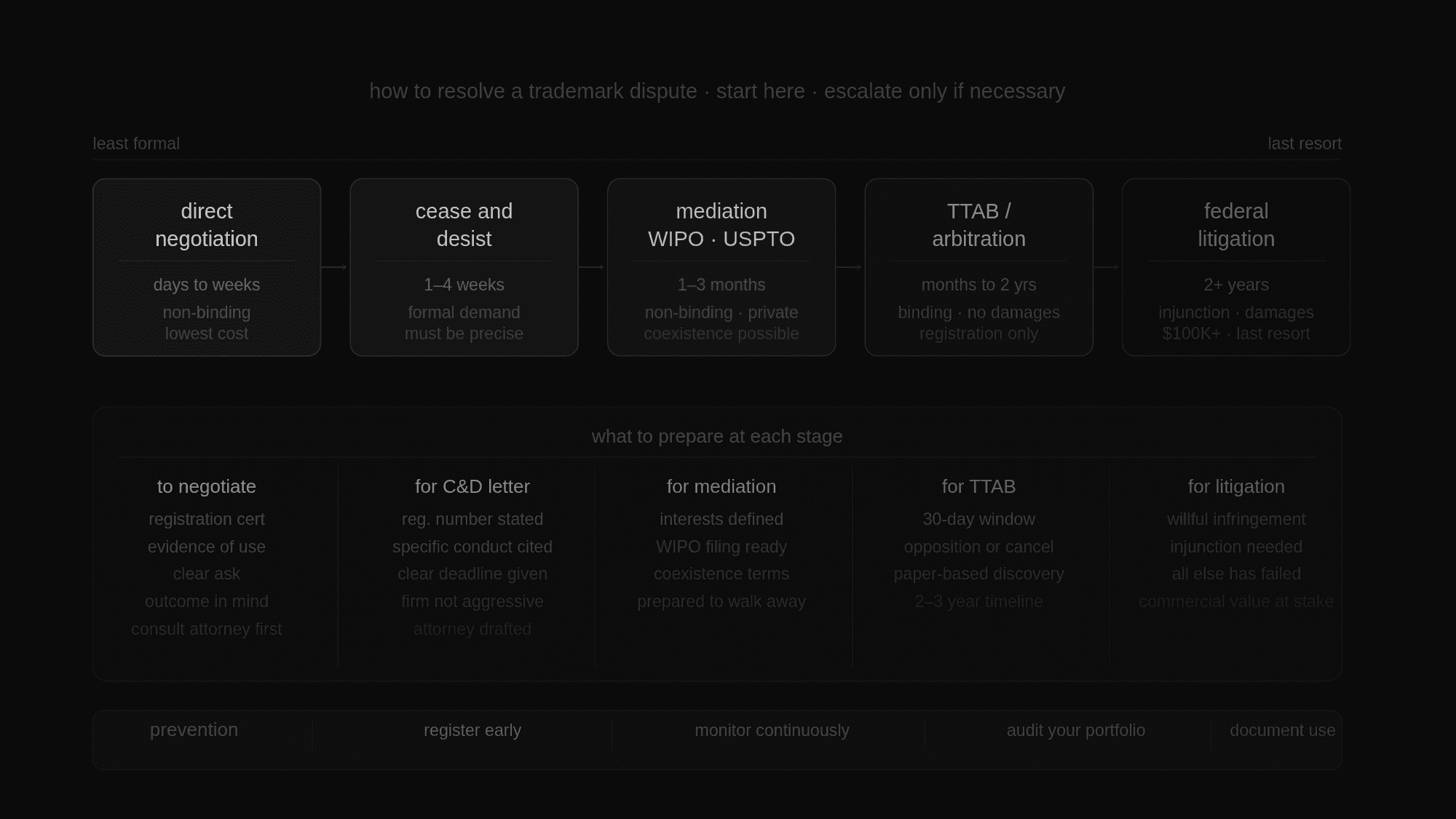
Most trademark disputes don't end in a courtroom. The ones that do are usually the ones that could have been resolved earlier, cheaper, and with less damage to both parties — if someone had made the right move at the right time.
Federal trademark litigation is expensive, slow, and unpredictable. A single case can run six figures before it reaches trial, take two or more years to resolve, and generate the kind of public attention neither party wants. For most businesses, that outcome is a last resort, not a strategy.
The good news: there are several well-established paths to resolving trademark disputes without litigation. This post walks through each one — what they are, when to use them, and how to approach them effectively.
What causes trademark disputes?
Trademark disputes typically arise from one of three situations: a newer brand that adopted a mark without conducting a proper clearance search, a bad-faith filer who registered a similar mark intentionally to block or monetize it, or two businesses that grew into each other's space over time without either party initially being aware of the conflict.
The legal standard that determines whether a dispute has merit is "likelihood of confusion" — whether an ordinary consumer might be confused about the source of goods or services. Courts weigh factors including the similarity of the marks in appearance, sound, and meaning; the similarity of the goods or services; the channels of trade; and the strength of the senior mark. Understanding where your situation falls on those factors is the first step to knowing how aggressively to pursue or defend a dispute.
Before escalating to any formal process, most trademark disputes can and should begin with a direct conversation between the parties.
This sounds obvious, but it's frequently skipped. A brand owner receives a cease-and-desist, feels threatened, and immediately calls their attorney to fire back. The other side responds in kind. What could have been a five-minute phone call becomes a six-month correspondence battle.
Direct negotiation works best when the conflict is genuinely ambiguous — two brands in adjacent markets, a newer company that may not have been aware of your registration, or a situation where a coexistence agreement could protect both parties without either one giving up their mark.
When initiating dialogue, be specific about what you're asking for. "Stop using our mark" is a demand. "We'd like to discuss a coexistence agreement that limits your use to X geography and Y product category" is a starting point for a deal. The second approach is far more likely to produce a resolution.
Come prepared with your registration details, evidence of your mark's use, and a clear sense of what outcome you actually need. The goal is resolution, not escalation.
Mediation: structured negotiation with a neutral third party
If direct negotiation stalls, mediation is the next step — and often the most underused tool in trademark dispute resolution.
Mediation brings both parties together with a neutral mediator whose job is to facilitate a productive conversation, not to decide who's right. The process is confidential, non-binding (either party can walk away), and significantly faster and cheaper than arbitration or litigation.
The mediator helps each side articulate their interests, identify where they actually overlap, and work toward a resolution both can accept. In trademark disputes, that resolution often takes the form of a coexistence agreement, a licensing arrangement, or one party agreeing to modify their mark to reduce the likelihood of confusion.
Mediation is particularly effective when there's an ongoing business relationship at stake, or when both parties want to avoid the publicity of a formal proceeding. The World Intellectual Property Organization (WIPO) operates a dedicated mediation center for IP disputes, and the USPTO encourages its use as an alternative to TTAB proceedings.
Arbitration: a binding decision outside the courts
Arbitration is more formal than mediation and produces a binding outcome. Both parties present their arguments and evidence to a neutral arbitrator (or panel), who issues a decision that both sides are contractually obligated to follow.
For trademark disputes, arbitration is most appropriate when the parties want a definitive resolution but want to avoid the cost, delay, and public record of federal court. It's faster than litigation, the proceedings are private, and the arbitrator can be selected for their IP expertise — which is often an advantage over a generalist judge.
The main tradeoff is finality. Unlike a court judgment, an arbitration award is extremely difficult to appeal. Before agreeing to arbitration, make sure you're confident in your position and understand what a losing outcome would mean for your brand.
Arbitration is also commonly used in international trademark disputes, where questions of jurisdiction make court proceedings complicated. WIPO and the American Arbitration Association both administer trademark arbitration programs with established rules and experienced arbitrators.
The TTAB: USPTO's own dispute resolution board
The Trademark Trial and Appeal Board is the USPTO's internal tribunal for trademark disputes. It handles two primary types of proceedings: oppositions (filed during the 30-day window after a trademark application is published for opposition) and cancellations (filed to invalidate an existing registration).
TTAB proceedings are less expensive than federal litigation and are conducted entirely on paper, which reduces the cost of discovery. However, they are not fast — contested TTAB cases routinely take two to three years to resolve — and the TTAB can only decide whether a mark should be registered or cancelled. It cannot award damages or issue injunctions. If you need to stop someone from using a mark immediately, TTAB alone won't get you there.
TTAB is most useful when you discover a conflicting application during examination (opposition is often more efficient than waiting for registration and then seeking cancellation) or when you need to clear a registered mark that's blocking your own application.
When you need a cease-and-desist letter
A cease-and-desist letter is not a lawsuit. It's a formal written demand that the other party stop the infringing activity. Sent correctly, it can resolve a dispute without any further action. Sent badly, it can inflame the situation, create a public record that works against you, or prompt the other party to file a declaratory judgment action — essentially racing to court before you can.
An effective cease-and-desist letter:
Identifies your registered mark and registration number clearly
Describes the infringing conduct specifically
States what you're asking the other party to do and by when
Is firm without being unnecessarily aggressive
The tone and precision of this letter matters more than most people realize. A vague or overbroad demand invites pushback. A well-drafted letter that clearly demonstrates your rights and gives the other party a clear path to compliance is far more likely to produce results.
When litigation is actually the right answer
All of the above said, there are situations where litigation is the appropriate and necessary response.
If the infringer has ignored multiple demands and continues to cause active harm to your brand, negotiation and mediation have failed, the infringing use is willful and causing significant damage, or you need emergency injunctive relief to stop the conduct immediately — federal court may be your only real option.
Federal trademark litigation allows you to seek injunctive relief, monetary damages (including the infringer's profits in some cases), and in willful infringement cases, attorneys' fees. For brands with substantial commercial value at stake, litigation is sometimes the only proportionate response.
The key is treating it as a last resort, not a first move. Businesses that jump straight to litigation often find that the process costs more than the dispute was worth. Businesses that exhaust the alternatives first, and litigate only when necessary, tend to get better outcomes at lower cost.
How to protect yourself before disputes arise
The most effective trademark dispute strategy is one that prevents disputes from escalating in the first place.
Register early. A federal registration gives you presumptive rights nationwide and the legal tools to enforce them. Unregistered marks are harder to defend and less likely to produce favorable outcomes in any dispute resolution process.
Monitor continuously. Most trademark disputes can be caught early if you're watching for them. Set up monitoring for new USPTO filings, marketplace listings, domain registrations, and social media accounts that could infringe your mark. Early detection almost always means earlier, cheaper resolution.
Audit your portfolio regularly. Review your registrations to confirm they're current, cover the right classes, and reflect how you're actually using your marks in commerce. Gaps in your portfolio are vulnerabilities that become apparent when disputes arise.
Document your use. Maintain records of when you first used your mark, in what markets, and for what goods and services. This documentation is essential in any dispute where priority of use is at issue.
Frequently asked questions
What is the first step when I discover a trademark conflict?
Start by gathering your documentation: your registration certificate, evidence of use, and a clear description of the infringing conduct. Then consult a trademark attorney before taking any public action. How you respond in the first days of a dispute often shapes how the entire situation unfolds.
How long does trademark mediation take?
Most trademark mediations conclude within one to three months, depending on scheduling and the complexity of the dispute. This compares favorably to TTAB proceedings (often two or more years) and federal litigation (often longer).
Can I send a cease-and-desist letter myself?
Technically yes, but it carries real risk. An imprecise or overbroad cease-and-desist can prompt the other party to seek a declaratory judgment in their preferred jurisdiction before you're ready to litigate. Attorney-drafted letters are more effective and reduce the chance of unintended escalation.
What is a coexistence agreement?
A coexistence agreement is a contract between two trademark owners that allows both parties to use similar marks under defined conditions — typically with geographic or product category restrictions. They're a common outcome of successful trademark negotiations and mediation, and they can eliminate ongoing dispute risk for both parties.
Does the USPTO help resolve trademark disputes?
The USPTO's Trademark Trial and Appeal Board handles oppositions and cancellations, which are formal proceedings within the trademark system. The USPTO itself does not mediate private disputes or enforce trademark rights — enforcement is the responsibility of the trademark owner.
What happens if I ignore a cease-and-desist letter?
Ignoring a cease-and-desist letter typically escalates the situation. The sending party may file an opposition, cancellation, or federal lawsuit. In some cases, continued infringement after receiving a demand letter is used as evidence of willfulness, which can increase damages in litigation.
Trademark disputes are stressful, but they don't have to be ruinous. The businesses that navigate them best are the ones that act early, stay strategic, and know when to negotiate and when to escalate.
If you're facing a trademark conflict — or want to make sure your brand is protected before one arises — contact Ana Law to schedule a strategy session.