Article
Apr 8, 2026
Why Your Startup Needs IP Assignments Before You Raise Money
Missing IP assignments are the most common deal-killer in startup fundraising. Learn why IP assignments matter, what they cover, and how to get them right before you raise.
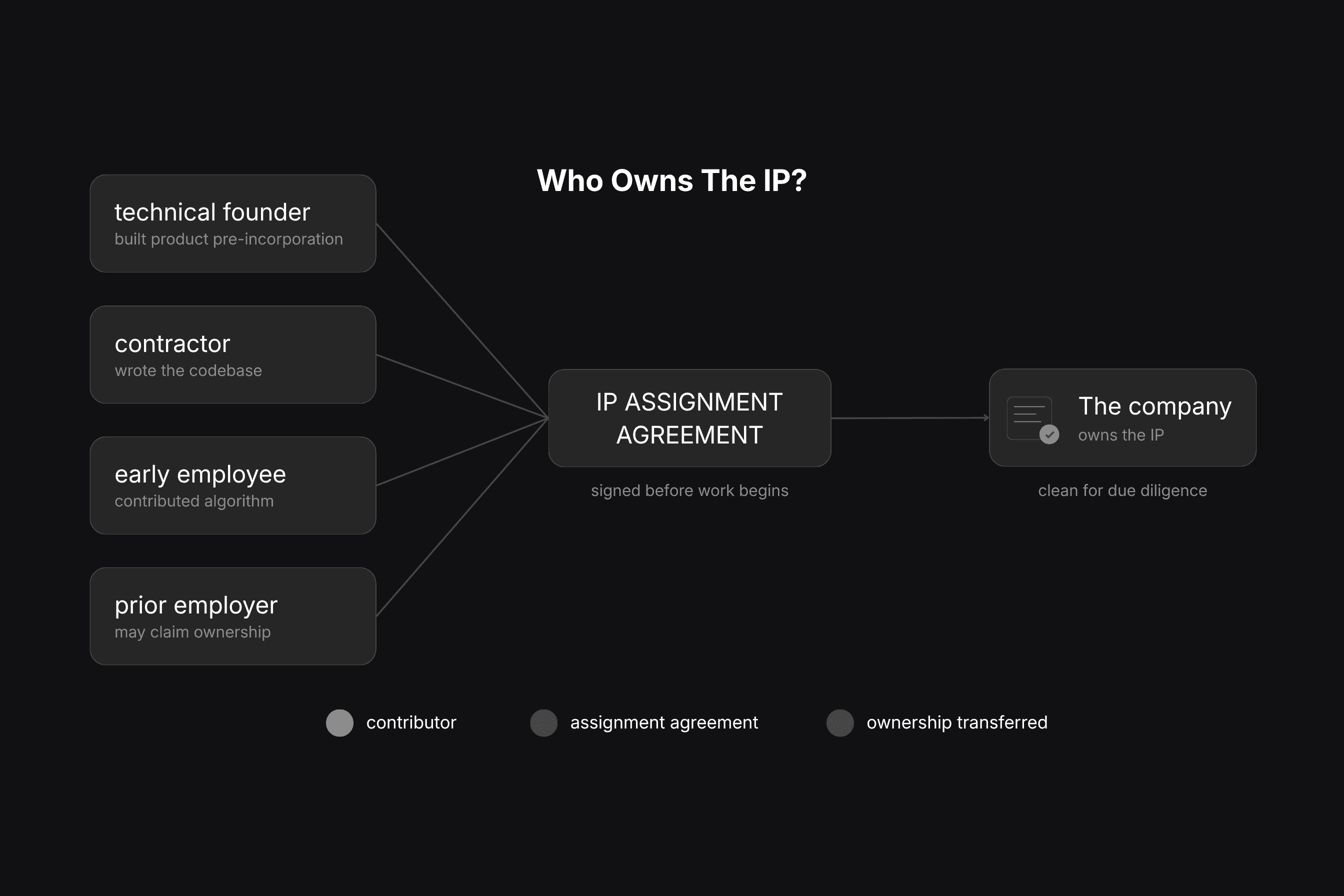
The most common IP mistake startups make is not a complicated one. It is not a patent dispute or a trademark infringement claim. It is something far more basic: the technology the company is built on was never formally transferred to the company in the first place.
This happens more often than investors, founders, or attorneys would like to admit. A technical co-founder builds the core product before the company is incorporated. A contractor writes the first version of the codebase. An early employee contributes a breakthrough algorithm over a weekend. None of them sign a document transferring their work to the company. Years later, when a Series A investor asks who owns the technology, the honest answer is: we are not entirely sure.
That answer ends deals. It reprices them. It generates legal fees, delays, and anxiety that would have been entirely avoidable with a simple document signed at the right time.
This post explains what IP assignments are, why they matter, what they need to cover, and how to make sure your startup's IP ownership is airtight before you raise.
What an IP assignment is and why it matters
An IP assignment is a written agreement that transfers ownership of intellectual property from one party to another. When a founder, employee, or contractor creates something — code, a design, a process, a piece of writing, a novel technical method — that creation belongs, by default, to the person who made it. An IP assignment changes that default by formally transferring ownership to the company.
Without an assignment, the company has at best a license to use the IP and at worst no rights at all. A license is not ownership. It can be revoked. It does not appear on a balance sheet as a company asset. It does not give investors confidence that the company controls its own technology.
The reason IP assignments matter specifically in the fundraising context is that investors are buying a stake in the company's future value. A significant portion of that value, for most technology startups, is the IP. If the IP is not clearly owned by the company, the investment thesis is built on a foundation investors cannot verify. Sophisticated investors — and their counsel — will find that problem in due diligence every time.
The four assignment gaps that surface most often in due diligence
1. The pre-incorporation founder assignment
This is the most common and most consequential gap. A technical founder spends six months building the core product before the company is formed. The company is incorporated. Everyone celebrates. No one thinks to document that the pre-incorporation work needs to be transferred to the new entity.
From a legal standpoint, that work belongs to the founder as an individual. The company has no formal rights to it. If the founder later leaves, becomes a dispute counterparty, or is acquired by a competitor, the lack of a formal assignment creates leverage the company should never have allowed.
The fix is straightforward: a written IP assignment agreement in which the founder transfers all pre-incorporation IP related to the company's business to the company, typically in exchange for nominal consideration. This agreement should be executed at or before incorporation, and it should specifically cover all IP created before the company was formed, not just IP created after.
2. The contractor codebase
The default rule under US copyright law is that the author of a work owns the copyright. For employees, work created within the scope of employment is a work made for hire, and the employer owns it. For independent contractors, the work-made-for-hire doctrine applies only to a narrow list of categories, and software code is not on that list.
This means that a contractor who writes code for your startup owns that code unless they have signed a written agreement assigning it to the company. A verbal agreement is not sufficient. Payment for the work is not sufficient. The contractor's understanding that the work belongs to you is not sufficient. Only a written assignment transfers ownership.
Many early-stage startups rely heavily on contractors to build their initial product. If those contractors did not sign IP assignment agreements, the company may not own significant portions of its own codebase. This is a due diligence finding that creates immediate concern because it is not always possible to go back and get signatures, particularly from contractors who have moved on, are now working for competitors, or cannot be located.
3. The employee who builds on personal time
Several states, including California, limit the scope of employee IP assignment agreements. California Labor Code section 2870 provides that an employer cannot require an employee to assign rights to an invention that the employee developed entirely on their own time without using the employer's equipment, supplies, facilities, or trade secret information, and that does not relate to the employer's business or reasonably anticipated research or development.
This creates a legitimate carve-out for employees who build things genuinely unrelated to their employer's business on their own time. But it also creates ambiguity for employees who built things before joining the company, or who contributed to a startup on nights and weekends while employed elsewhere.
Investors will look carefully at whether any of the company's core technology was developed by someone who might have a legitimate claim that the work falls outside a valid IP assignment. The analysis is fact-specific and sometimes uncomfortable, particularly when it involves a founding team member who did early development work while still employed at another company.
4. The prior employer claim
When founders or key engineers come from other technology companies, their former employment agreements often include broad invention assignment provisions. If any of the company's core technology was developed using prior employer resources, during prior employer work time, or relates to work the person was doing for the prior employer, the prior employer may have a legal claim to that technology.
This is not a theoretical risk. There are documented instances of technology companies asserting ownership claims over startup technology developed by former employees. The claims are not always meritorious, but defending against them is expensive and creates exactly the kind of uncertainty that investors want to avoid.
A founder disclosure process that asks each technical founder and key employee to review their prior employment agreements and identify any potential overlap with the company's technology is the minimum reasonable step. Where overlap exists, legal counsel should evaluate the risk and document the analysis.
What a proper IP assignment agreement covers
An IP assignment agreement for a founder or employee should cover the following.
All pre-incorporation IP. The agreement should specifically address IP created before the company was incorporated, not just IP created during employment. The temporal scope matters because pre-incorporation work is where the gap most often exists.
Broad definition of IP. The agreement should define IP broadly to include patents and patent applications, copyrights, trade secrets, trademarks, know-how, inventions, discoveries, improvements, and any other intellectual property rights, whether or not registerable. Narrow definitions create gaps that clever parties can exploit later.
Waiver of moral rights. In some jurisdictions, authors retain moral rights in their works that cannot be overridden by assignment. For companies operating internationally or with team members who are citizens of countries with strong moral rights protections, the agreement should include a waiver of moral rights to the extent permitted by applicable law.
Cooperation obligations. The agreement should require the assignor to cooperate with the company's efforts to protect the assigned IP, including signing additional documents, assisting with patent applications, and testifying in proceedings. This cooperation obligation survives termination of the employment or engagement relationship.
Consideration. An assignment needs consideration to be enforceable as a contract. For founders, the consideration is typically the founder's equity in the company. For employees, it is employment and compensation. For contractors, it is the fees paid for the engagement. The agreement should recite adequate consideration, and for assignments signed after the employment or engagement has begun, additional consideration may be required in some states.
State-specific compliance. Several states limit what can be assigned. California, Delaware, Minnesota, North Carolina, Washington, and Illinois all have statutes that carve out certain employee inventions from mandatory assignment. The agreement needs to comply with the law of each state where team members are located, which may require state-specific versions or addenda.
When to get assignments signed
The right time to get IP assignments signed is before any IP is created in connection with the company's business. In practice, that means:
At incorporation for founders: every founder should sign an IP assignment agreement on the day the company is formed, covering all pre-formation IP related to the business.
Before work begins for employees: IP assignment provisions should be included in the offer letter or employment agreement, signed before the first day of work. Getting a signature after employment begins can raise consideration issues in some states and creates unnecessary risk.
Before the engagement begins for contractors: the contractor agreement should include IP assignment provisions, signed before any work is performed. Never pay a contractor for work without a signed agreement that assigns the IP.
The closer you get to a fundraising event, the harder it becomes to get assignments signed on favorable terms. A founder who is being asked to sign an IP assignment during a term sheet negotiation has leverage they would not have had at founding. A contractor who knows the company is raising money may demand compensation for a signature they should have provided as a matter of course.
What happens when you cannot get an assignment signed
Sometimes the person who needs to sign is unavailable, uncooperative, or demands unreasonable compensation. This situation is more common than it should be, and it requires a risk assessment rather than a simple fix.
The options, roughly in order of preference: negotiate a reasonable assignment agreement, potentially with additional consideration; obtain a broad, irrevocable license if assignment is not possible; conduct a technical assessment of how much the company's current product depends on the unassigned IP and whether it can be rebuilt without that contribution; and disclose the gap to investors with a clear account of what steps have been taken to address it.
What does not work is ignoring the gap and hoping investors will not find it. They will find it, and discovering that you knew about it and did not disclose it is substantially worse than discovering the gap itself.
Frequently asked questions
Does paying a contractor for their work mean the company owns the IP?
No. Payment transfers money, not IP rights. Under US copyright law, a contractor who is paid for their work still owns the copyright in that work unless they have signed a written agreement assigning it to the company or the work qualifies as a work made for hire under the narrow statutory definition. Code, designs, and most other contractor deliverables do not automatically qualify as works made for hire.
Can an IP assignment be signed after the work is already done?
Yes, a retroactive IP assignment is legally valid as long as it is supported by adequate consideration. For employees, continued employment is typically sufficient consideration. For founders signing at or near the time of incorporation, equity is typically sufficient. The risk of retroactive assignments is that the person who needs to sign may be harder to reach, less cooperative, or better positioned to negotiate than they would have been at the outset.
What is the difference between an IP assignment and a non-disclosure agreement?
An NDA requires a party to keep information confidential. It does not transfer ownership of IP. An IP assignment transfers ownership. They serve different purposes and both are needed in most founder, employee, and contractor relationships. An NDA without an IP assignment gives you confidentiality without ownership. An IP assignment without an NDA gives you ownership without confidentiality protection. You need both.
Do investors require IP assignments as a condition of closing?
Yes. Standard venture capital closing conditions include representations that the company owns all IP material to its business, and those representations require that valid IP assignments are in place from all material contributors. If assignments are missing, investors will require them to be obtained before closing or will escrow a portion of the investment pending their execution.
What if a co-founder refuses to sign an IP assignment?
A co-founder who refuses to sign an IP assignment is asserting that they personally own technology the company is built on. This is a serious governance and business problem that goes beyond IP. It suggests a misalignment about the nature of the relationship that needs to be resolved before the company takes any outside investment. The resolution may involve negotiation, legal action, or restructuring the co-founder relationship, and it requires counsel who understands both the IP and the equity implications.
IP assignments are the legal infrastructure that makes everything else about your startup work. Your trademark, your patent filings, your trade secret claims, your investor representations — all of them depend on the company actually owning the technology it is built on. That ownership does not happen automatically. It happens because someone sat down and signed a document at the right time.
Getting those documents in place before you raise is one of the highest-leverage legal steps a founder can take. If you want to audit your startup's IP assignments or put the right agreements in place before your next fundraise, contact Ana Law to schedule a strategy session.