Article
Apr 8, 2026
Patent Litigation Trends: What the Latest Federal Court Rulings Mean for Your IP Strategy
Learn the latest patent litigation trends affecting startups and tech companies. Understand recent court decisions, NPE activity, and how to manage patent risk.
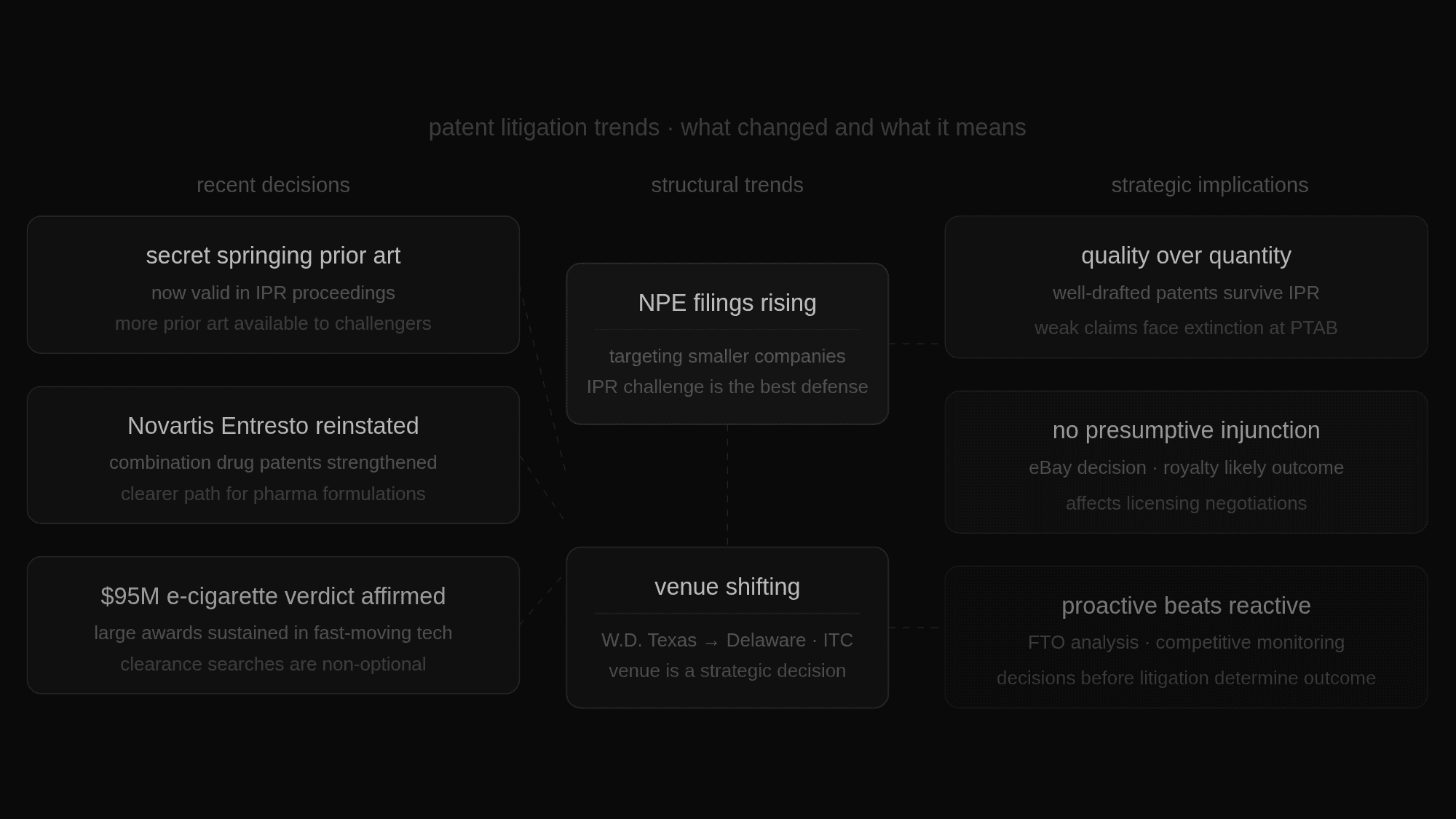
The patent litigation landscape in the United States is shifting in ways that matter to every technology company, pharmaceutical innovator, and startup building on proprietary IP. Recent Federal Circuit decisions have expanded the scope of prior art challenges, reinstated significant pharmaceutical patent claims, and affirmed nine-figure verdicts in emerging technology disputes. At the same time, non-practicing entity filings are rising and preferred litigation venues are redistributing across the country.
If your company holds patents, is building toward a portfolio, or is operating in a space where infringement risk is real, these trends affect your strategy right now. Here's what's changed and what it means.
Three federal court decisions reshaping patent litigation
"Secret springing" prior art is now fair game in inter partes reviews
The Federal Circuit recently upheld a significant expansion of what counts as prior art in inter partes review (IPR) proceedings. Specifically, the court affirmed that "secret springing" prior art — information that was not publicly available at the time of a patent's filing date but became public before its critical date — can be used to challenge a patent's validity.
This is a meaningful shift for patent challengers. IPR proceedings before the Patent Trial and Appeal Board (PTAB) are already one of the most efficient tools for invalidating patents. Expanding the prior art pool gives challengers more ammunition and makes it harder for patent holders to predict what prior art could be raised against them.
The practical implication: if you hold patents that were filed in a period where related research was circulating but not yet published, those patents face increased vulnerability in IPR proceedings. Patent prosecution strategy needs to account for this — both in how applications are drafted and in how prior art is disclosed during prosecution.
Novartis' Entresto patent claims reinstated
In a significant win for pharmaceutical patent holders, the Federal Circuit reinstated Novartis' patent claims on Entresto, its combination heart failure drug, after a lower court had invalidated them. The decision strengthens the legal framework for protecting combination drug formulations — a category that has historically faced difficult patentability challenges.
For pharma and biotech companies, this ruling is a meaningful signal. Combination therapies and formulation patents, which often occupy a gray area in patentability analysis, received a clearer path to enforceability. Companies developing similar products now have a stronger precedent to rely on when prosecuting and defending these patents.
$95 million verdict affirmed in e-cigarette patent dispute
A federal appeals court upheld a $95 million damages award in a patent infringement case involving e-cigarette technology. The size of the verdict alone commands attention, but the more important signal is the court's willingness to sustain large awards in a fast-moving consumer technology sector where product cycles are short and patent portfolios are often underdeveloped.
For companies in emerging consumer technology categories, this case is a clear warning: patent exposure in rapidly growing markets can be financially catastrophic. Clearing your product against existing patents before launch is not optional. And for IP holders in these spaces, the ruling demonstrates that enforcement can be commercially significant.
The two biggest structural trends in patent litigation right now
NPE filings are rising — and targeting a wider range of companies
Non-practicing entities — organizations that hold patents but don't manufacture or sell products — continue to increase their filing volume. NPE litigation used to be concentrated on large technology companies with deep pockets. That's changing. Smaller companies, mid-market businesses, and startups are increasingly receiving demand letters and facing suits from NPEs who have identified licensing revenue opportunities.
The economics of NPE litigation favor early settlement. Legal defense costs in patent cases routinely reach seven figures before trial. NPEs understand this and often price demand letters just below what it would cost to fight. For companies without experienced patent counsel, this creates real pressure to settle claims that might be successfully defended.
The more aggressive response — and the one that's changing the NPE calculus — is challenging the validity of the asserted patents through IPR. Large companies are doing this systematically, and the success rate at PTAB has been high enough that NPEs now factor invalidation risk into their targeting decisions. Smaller companies that can organize this kind of defense are in a meaningfully better position than those that can't.
Venue is shifting — and it matters more than most companies realize
Where a patent case is filed has always influenced its outcome. Different courts have different average time-to-trial, different track records on claim construction, different judges with varying levels of patent expertise, and different jury pools. These aren't minor differences — they can determine whether a patent survives challenge and what damages look like.
The Western District of Texas, which became the dominant patent venue due to its fast dockets, has seen its caseload redistributed following rule changes that limited forum shopping. Delaware has absorbed a significant share of the increase, driven by its experienced patent judiciary and the fact that many companies are incorporated there. The International Trade Commission (ITC) is also seeing more activity, particularly in cases involving imported products, where its exclusion order remedy is faster and more powerful than injunctive relief from a district court.
For patent holders, the choice of venue is now a more deliberate strategic decision than it was three years ago. For companies defending against infringement claims, understanding the characteristics of the court you're in — and whether transfer motions are viable — is part of early case strategy.
What these trends mean for patent holders and innovators
Your portfolio's quality matters more than its size
The current environment rewards well-drafted, properly scoped patents over large volumes of weaker ones. PTAB invalidation rates remain high enough that patents with drafting weaknesses face real extinction risk in IPR proceedings. The expansion of prior art that can be raised against patents at PTAB makes this more acute.
Investment in patent prosecution quality — working with counsel who understands both the technical subject matter and the current claim construction environment — is not a cost center. It's protection against the scenario where your most valuable patents get invalidated before you can use them.
Injunctive relief is no longer presumptive
One of the most consequential changes in patent enforcement over the past decade is the eBay decision's elimination of the presumption of injunctive relief following a finding of infringement. Patent holders who win on infringement and validity still need to make a separate showing that they're entitled to an injunction. Many don't get one.
This changes the economics of enforcement and licensing. If the realistic outcome of successful litigation is a reasonable royalty rather than an injunction, that affects how you approach pre-litigation licensing conversations, how you structure demand letters, and what you're willing to accept in settlement.
Proactive patent strategy outperforms reactive enforcement
The companies that navigate patent litigation trends best are the ones that treat IP strategy as a forward-looking business function rather than a reactive legal one. That means:
Filing patents with prosecution quality that can withstand IPR challenge. Identifying the right classes and claims to cover both current and anticipated products. Monitoring the competitive landscape for potentially conflicting filings. Conducting freedom-to-operate analysis before product launches in high-risk categories. Building the documented use record that supports both enforcement and defense.
The $95 million e-cigarette verdict happened because someone had a strong patent and the willingness to enforce it. The companies on the wrong side of NPE suits often got there because they didn't conduct clearance searches before building. Neither outcome is accidental.
Frequently asked questions
What is inter partes review and why does it matter?
Inter partes review is a PTAB proceeding that allows third parties to challenge the validity of an issued patent based on prior art. It's faster and significantly less expensive than district court litigation, and PTAB has historically invalidated a high percentage of challenged claims. IPR has become the primary tool for defendants and NPE targets to challenge patent validity, and its strategic importance has grown as courts have affirmed its scope and PTAB's authority.
How do I know if my company is at risk from NPE litigation?
NPEs typically target companies in sectors with dense patent activity, companies that have achieved visible commercial success, and companies that operate in spaces where foundational patents were filed early but products came later. Technology, consumer electronics, e-commerce, and healthcare technology are all high-exposure categories. If your product operates in any of these spaces and you haven't conducted a freedom-to-operate analysis, you have unknown exposure.
What's the difference between a district court patent case and an ITC proceeding?
District courts handle damages and can issue injunctions. The ITC can issue exclusion orders that block infringing products from entering the US market — often more quickly and with a lower burden than obtaining a district court injunction. The ITC cannot award monetary damages. Many patent holders pursue parallel proceedings: ITC for the immediate exclusion remedy, district court for damages.
How has the shift in venue away from the Western District of Texas affected patent litigation?
The Western District of Texas attracted heavy patent filings because of its fast trial schedule and plaintiff-friendly reputation. Rule changes requiring cases to be assigned to judges with jurisdiction over the location where defendants actually operate redistributed a significant volume of cases. Delaware, the Northern District of California, and the District of New Jersey have absorbed the most activity. The practical effect for litigants is that average time-to-trial has increased in some transferred cases, and defendants in major tech hubs are more likely to litigate at home.
Should smaller companies fight NPE suits or settle?
It depends on the strength of the asserted patent, the size of the demand, and your appetite for disruption. IPR petitions have a strong track record of invalidating NPE patents, and a filed petition often produces a settlement on better terms than pre-suit demands. The decision to fight should be made with patent counsel who has evaluated the asserted claims and the likely IPR outcome — not based solely on the cost of defense. Settling weak NPE claims without challenge can invite follow-on suits.
Patent litigation trends reward the prepared. Whether you're enforcing your own portfolio, defending against an NPE, or building IP strategy for a company that's scaling, the decisions you make before litigation starts determine most of the outcome.
If you want to evaluate your patent portfolio, assess your litigation exposure, or build an enforcement strategy around recent rulings, contact Ana Law to schedule a strategy session.