Article
Apr 8, 2026
Patent Trolls: How They Operate, What Courts Are Doing, and How to Protect Your Business
Learn what patent trolls are and how to respond to patent infringement claims. Understand NPE tactics, legal defenses, and how to protect your business.
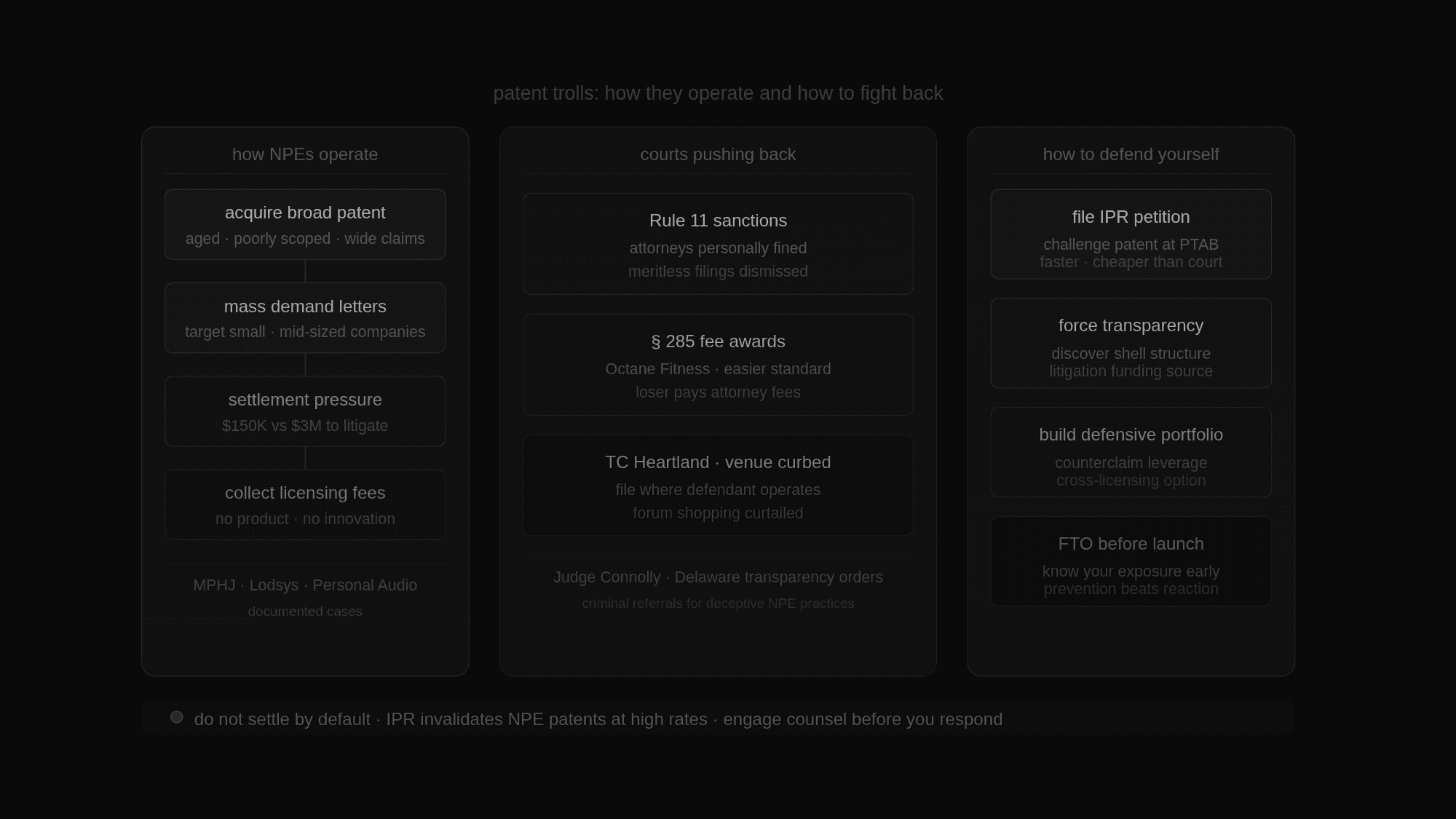
A patent troll doesn't invent anything. It doesn't manufacture anything. It acquires patents — often broad, aging, or poorly scoped ones — for the sole purpose of sending demand letters and filing infringement suits against companies that actually do build things.
The business model works because defending a patent lawsuit is expensive regardless of merit. A fully litigated patent case routinely costs $3 million or more in legal fees. A demand letter offering to settle for $150,000 looks attractive by comparison, even if the underlying patent is weak. Patent trolls, formally called non-practicing entities (NPEs), have monetized this asymmetry for decades.
But the legal environment is shifting. Federal courts are imposing sanctions on serial litigants, the Supreme Court and Federal Circuit have tightened the rules, and judges are scrutinizing NPE tactics with more skepticism than at any point in recent history. Here's what's happening and what it means for your business.
How patent trolls operate
The core tactic is straightforward: acquire a patent broad enough to read on technology that's already in widespread use, then send demand letters to as many potential infringers as possible. The targets are often small and mid-sized businesses — companies that lack in-house patent counsel, can't absorb years of litigation, and are more likely to settle quickly.
Three cases illustrate the approach clearly.
MPHJ Technology sent demand letters to thousands of small businesses claiming that using a standard office scanner with email functionality infringed its patents. The company targeted businesses with no connection to the technology industry — dental offices, restaurants, accounting firms. Most had no idea they could challenge the patent's validity.
Lodsys targeted independent app developers with vague claims over in-app purchase functionality. The developers, many of whom were individuals or tiny startups, faced the choice of licensing fees or litigation costs that would have destroyed their businesses. Lodsys bet, correctly in many cases, that they would pay rather than fight.
Personal Audio sued podcasters claiming a patent on "episodic content" delivery — despite having no involvement in creating podcasting as a medium. The Electronic Frontier Foundation eventually led a successful crowdfunded campaign to invalidate the patent through inter partes review, but not before numerous podcasters faced real legal exposure.
The pattern across all three: broad patents, mass targeting, settlement pressure, and no actual product or service in the market.
The legal tools courts are using to push back
Federal courts have increasingly been willing to use the tools available to them to sanction abusive patent litigation. Two in particular have become central to the judicial response.
Rule 11 of the Federal Rules of Civil Procedure
Rule 11 requires attorneys to certify that every filing they make has a legitimate factual and legal basis. Judges can impose sanctions — monetary fines, case dismissal, or both — on attorneys who file claims that don't meet this standard. For patent cases, this means an attorney who files a clearly meritless infringement suit without conducting adequate pre-filing investigation can be personally sanctioned, not just the client.
Courts have become more willing to use Rule 11 proactively in patent cases, particularly against NPEs with histories of filing similar suits across multiple jurisdictions. The threat of personal sanctions on counsel has a real deterrent effect on the attorneys who enable serial patent troll litigation.
35 U.S.C. § 285: Attorney fee awards in exceptional cases
This statute allows courts to award attorney fees to the prevailing party in patent cases that qualify as "exceptional." The Supreme Court's 2014 decision in Octane Fitness v. ICON Health significantly lowered the bar for what counts as exceptional, making it substantially easier for defendants who successfully defeat frivolous patent suits to recover their legal costs from the plaintiff.
Before Octane Fitness, defendants had to meet a demanding standard — clear and convincing evidence of objective baselessness and subjective bad faith. The Supreme Court replaced that with a more flexible totality-of-the-circumstances test. Fee awards against NPEs have increased measurably since then, and the threat of paying the defendant's attorney fees is a meaningful deterrent for plaintiffs evaluating whether a case is worth filing.
Recent judicial actions signaling a harder line
Chief Judge Colm Connolly of the U.S. District Court for the District of Delaware has become one of the most prominent judicial voices against NPE abuse. His standing orders require patent plaintiffs to disclose their complete ownership and funding structure at the outset of litigation — a requirement designed to expose the shell company structures that many patent trolls use to obscure their identity and make judgment collection difficult.
In a series of cases, Judge Connolly investigated the litigation practices of a patent assertion entity and ultimately made criminal referrals based on what the investigation uncovered. The message to NPEs filing in Delaware — one of the most significant patent venues in the country — was explicit: transparency is required and deceptive practices will not be tolerated.
The Federal Circuit has supported this approach, affirming sanctions against entities that filed large volumes of weak patent suits and upholding deterrence-focused sanctions that went beyond simply compensating defendants for their fees.
The TC Heartland decision from the Supreme Court also reshaped the NPE landscape by tightening the rules on where patent suits can be filed. Before TC Heartland, NPEs could file in plaintiff-friendly venues regardless of where the defendant was located. After the decision, cases must be filed where the defendant is incorporated or has a regular place of business — significantly curtailing forum shopping.
Legislative efforts that haven't yet succeeded
Congress has tried repeatedly to pass comprehensive patent troll legislation. Two bills are worth understanding even though neither became law, because they illustrate where the legislative debate stands and what reforms may eventually pass.
The Innovation Act proposed heightened pleading requirements (forcing plaintiffs to provide more specific claim charts at filing), limited discovery until after claim construction, automatic fee shifting to losing parties in certain cases, and greater transparency in patent ownership. It passed the House with bipartisan support but stalled in the Senate, where pharmaceutical and university patent holders argued it would harm legitimate enforcement.
The Lawsuit Abuse Reduction Act of 2015 focused specifically on strengthening Rule 11, including making sanctions mandatory rather than discretionary and removing the 21-day safe harbor period that currently allows plaintiffs to withdraw frivolous claims before sanctions are imposed. Critics argued it would chill legitimate civil rights and consumer litigation alongside patent abuse.
Both bills reflect genuine legislative frustration with NPE abuse. Whether comprehensive reform passes or courts continue to carry the load through fee awards and sanctions remains to be seen.
What this means for your business
Understand your actual exposure
The first step is knowing whether your products or services are operating in spaces with significant NPE activity. Technology, e-commerce, software, consumer electronics, healthcare technology, and financial services are all high-exposure categories. If you're building in any of these spaces and haven't conducted a freedom-to-operate analysis, you have unknown risk.
Don't assume settlement is the only option
The instinct when a demand letter arrives is to calculate settlement cost against defense cost and write a check. In many cases that calculus ignores a third option: challenging the patent's validity through inter partes review at the Patent Trial and Appeal Board. IPR has a strong track record of invalidating NPE patents, and filing a petition often produces a settlement on significantly better terms than the original demand. It also removes the patent from play for other potential targets, which is why some companies challenge NPE patents even when they could afford to settle.
Force transparency
NPEs frequently operate through shell companies designed to obscure their identity, complicate fee collection, and make it difficult to identify who is actually controlling the litigation. Courts in Delaware and other venues are increasingly requiring disclosure of ownership and funding at the outset. If you're sued, early discovery into the plaintiff's corporate structure and litigation funding arrangements is now a standard defensive move.
Build your defensive portfolio
Companies with their own patent portfolios have something NPEs don't: the ability to assert counterclaims or threaten cross-licensing negotiations. A defensive patent portfolio doesn't need to be large to be effective — it needs to cover enough of your core technology that a potential NPE target has to weigh the cost of being countersued. This is particularly relevant for companies that have been building products for years without filing patents.
Frequently asked questions
What exactly is a patent troll?
A patent troll, or non-practicing entity, is a company or individual that acquires patents not to develop products but to assert them against companies that do. NPEs generate revenue through licensing fees and litigation settlements rather than through any commercial activity related to the patented technology. The term is pejorative — some NPEs prefer "patent assertion entity" — but the business model is the same regardless of label.
Can I challenge a patent troll's patent without going to court?
Yes. Inter partes review allows you to challenge the validity of an issued patent at the Patent Trial and Appeal Board, which is part of the USPTO rather than a federal court. IPR is faster and significantly less expensive than district court litigation, and PTAB has historically invalidated a high percentage of challenged claims. Many companies file IPR petitions immediately upon receiving a demand letter, which often shifts the settlement dynamic in their favor.
What should I do when I receive a patent troll demand letter?
Do not ignore it and do not respond immediately without counsel. The response deadline in the letter is typically not a legal deadline. Have a patent attorney evaluate the asserted patent, assess the strength of the infringement claim, and identify whether IPR is a viable option before you respond. How you respond in the first weeks of a demand shapes the entire trajectory of the dispute.
How do courts determine whether a patent case is "exceptional" enough to award attorney fees?
Under the Octane Fitness standard, courts look at the totality of the circumstances, including the objective weakness of the plaintiff's legal position, any evidence of bad faith or vexatious conduct, the plaintiff's litigation history, and whether the case was filed for an improper purpose. Serial filers and NPEs that have been sanctioned in prior cases face a higher risk of fee awards in subsequent litigation.
Does being a small business reduce my risk of being targeted?
In the early days of NPE litigation, small businesses were actually preferred targets because they were less likely to fight back. That dynamic has shifted somewhat as legal aid organizations, industry groups, and even some larger companies have provided defensive resources to small business targets. But small businesses without patent counsel remain vulnerable, particularly to demand letters that don't immediately escalate to suit.
Patent trolls remain a real threat to businesses of every size, but the legal environment has never been less hospitable to abusive NPE tactics than it is today. Courts are sanctioning serial litigants, fee awards are easier to obtain, venue shopping has been curtailed, and judges are requiring transparency that makes shell company structures harder to maintain.
The businesses best positioned to handle NPE threats are the ones that know their exposure, have patent counsel they can call the day a demand letter arrives, and have thought about their defensive options before they need them.
If you've received a demand letter or want to assess your patent exposure before one arrives, contact Ana Law to schedule a strategy session.