Article
Apr 8, 2026
How to Protect Your Startup's Trade Secrets from Day One
Trade secrets are often a startup's most valuable asset. Learn what qualifies, what protection requires, and how to build the right systems before something goes wrong.
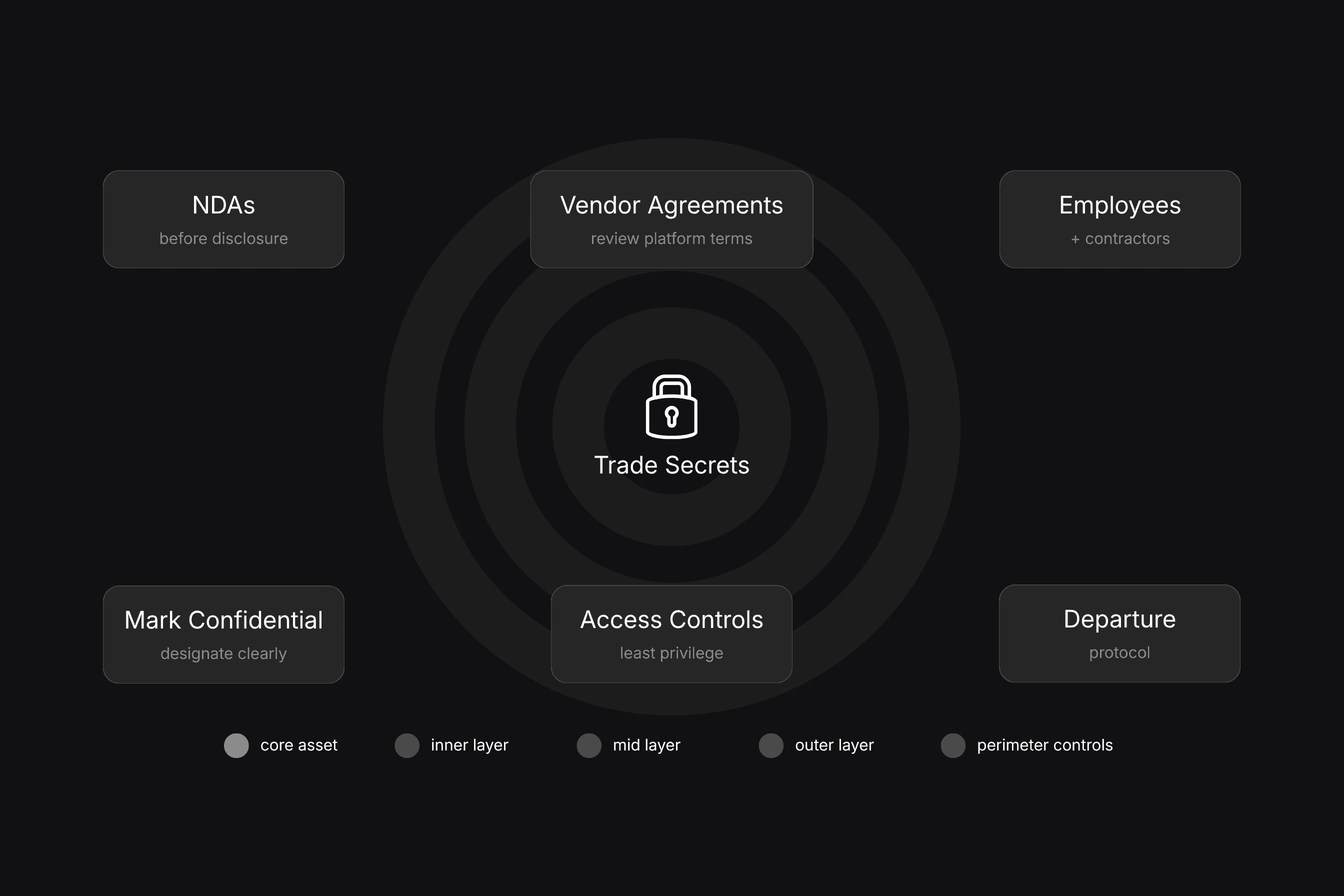
Most early-stage startups have no patents, no registered trademarks, and no formal IP portfolio. What they do have is knowledge: proprietary methods, datasets, algorithms, customer insights, pricing strategies, and technical approaches that competitors do not know about. That knowledge is often the most valuable thing the company owns, and it is protectable under trade secret law — but only if the company treats it that way from the beginning.
Trade secret protection does not require registration, does not require public disclosure, and has no expiration date. It requires only two things: that the information derives economic value from not being generally known, and that you take reasonable measures to keep it secret. The first condition is almost always satisfied for a startup's core technology. The second is where most startups fall short.
This post explains what qualifies as a trade secret, what reasonable protective measures actually look like, and how to build a system that holds up legally from the day you start building.
What counts as a trade secret
Under the Defend Trade Secrets Act and state equivalents based on the Uniform Trade Secrets Act, a trade secret can be virtually any business information that has commercial value from its secrecy. The definition is intentionally broad.
For startups, trade secrets commonly include:
Technical information: Source code, algorithms, model architectures, training datasets, model weights, system prompts, proprietary APIs, hardware designs, manufacturing processes, and technical specifications that are not publicly disclosed.
Business information: Customer lists, supplier relationships, pricing strategies, marketing plans, sales data, financial projections, and business methods that are not publicly available.
Research and development: Experimental results, failed approaches (which often have as much value as successful ones), research methodologies, and work-in-progress that has not yet been patented or published.
Operational knowledge: The specific combination of tools, workflows, and processes your team has developed to operate more efficiently than competitors. This category is underappreciated. The specific way your team builds, tests, and deploys software can itself be a trade secret even if each individual tool is publicly available.
The key is that the information is not generally known or readily ascertainable by others who could obtain economic value from it. Information that is publicly available, that can be easily reverse engineered from your product, or that competitors could independently develop without difficulty is not protectable as a trade secret regardless of how valuable it is to you.
The reasonable measures requirement: what it actually means
This is where most startups fail, and where trade secret claims fall apart in litigation. Courts do not protect trade secrets based on the owner's subjective belief that the information is confidential. They protect them based on whether the owner took objectively reasonable steps to maintain secrecy.
Reasonable measures are evaluated based on the totality of the circumstances, including the size of the company, the nature of the information, and industry norms. A five-person startup is not held to the same standard as a Fortune 500 company. But every company, regardless of size, needs to implement some systematic protective measures to preserve its trade secret claims.
The following are the baseline measures courts look for.
The foundational documents: NDAs and confidentiality agreements
Every person who receives access to your confidential information should sign a confidentiality agreement before access is granted. This is not optional, and it is not a technicality. It is one of the most important pieces of evidence you have that you treated the information as confidential.
Employees should sign confidentiality and IP assignment agreements before their first day of work. The confidentiality provisions should be explicit about what categories of information are confidential, survive termination of employment, and specify that the employee's obligations are not limited to information they know is designated as confidential. A well-drafted employee confidentiality agreement also includes a provision requiring the employee to return all company materials upon departure and certify that they have not retained copies.
Contractors and consultants need NDAs before any engagement begins. The NDA should cover the specific project and the broader category of information they may encounter. It should include return-of-materials provisions and should survive the end of the engagement indefinitely.
Potential investors, partners, and customers who receive confidential technical or business information during sales or fundraising conversations should sign NDAs before the disclosure, not after. Founders frequently make the mistake of sharing significant technical detail in investor meetings before an NDA is in place, under the assumption that investors do not sign NDAs for early conversations. That assumption is sometimes accurate but it does not mean you should share your most sensitive technical information without any protection.
Vendors and service providers who have access to your systems, your data, or your technical environment should have data processing agreements and confidentiality provisions that specifically address the confidential nature of what they can access.
Access controls: limiting who can see what
The principle of least privilege is as much a legal concept as a security one. Trade secret protection is stronger when access to the confidential information is limited to people who genuinely need it for their work.
For technical assets: Model weights, training datasets, proprietary algorithms, and source code for core features should be accessible only to team members with a specific need. Role-based access controls, audit logs that track who accessed what and when, and regular reviews of access permissions are baseline requirements. These controls also give you evidence in litigation — you can demonstrate exactly who had access to the information and when.
For business information: Customer lists, pricing data, financial projections, and strategic plans should be stored in systems with appropriate access controls and should not be shared in company-wide communications unless there is a specific reason. The informal culture of many early-stage startups, where everyone knows everything, can undermine trade secret protection for categories of information that should be more restricted.
For physical security: If your team works in a shared office or coworking space, be thoughtful about what is visible on screens, what is written on whiteboards, and what conversations happen in shared spaces. Physical security measures are relevant to the reasonable measures analysis even in the digital age.
Marking and designating confidential information
Courts look more favorably on trade secret claims when the company made affirmative efforts to designate information as confidential. This means:
Marking documents and files as "Confidential," "Proprietary," or "Trade Secret" where appropriate. This does not need to be on every internal document, but it should be consistent for materials you would not want a competitor to see.
Using confidentiality footers or headers on emails that contain sensitive technical or business information sent outside the company.
Including confidentiality notices in data rooms, technical documentation, and any other repository of sensitive information shared with third parties.
These designations are not legally determinative on their own, but they are evidence that the company was aware of the sensitive nature of the information and communicated that to people who received it.
Departure protocols: your highest-risk moment
The moment when a key employee leaves is when trade secret misappropriation is most likely to occur. Data transfers spike in the weeks before a resignation. Employees who are planning to join a competitor or start a competing company have both the motive and the access to take valuable information with them.
A robust departure protocol includes the following:
Exit interviews that specifically address the employee's confidentiality obligations, remind them of what they agreed to, and document that the reminder occurred.
Return of materials on the departure date, including all devices, access credentials, and physical materials. The departing employee should sign a certification that they have returned all company materials and have not retained copies.
Access revocation on or before the departure date. System access should be terminated promptly, and access logs should be reviewed for unusual activity in the period leading up to departure.
Forensic review for high-risk departures, particularly when an employee is leaving to join a direct competitor or start a competing company. Reviewing whether large volumes of data were transferred, whether external storage devices were connected, or whether email forwarding rules were set up can identify misappropriation before it compounds.
Non-solicitation and non-compete agreements where enforceable. Non-compete agreements are banned or severely limited in California and several other states, but non-solicitation of customers and employees is enforceable in more jurisdictions. These agreements should be in place from the beginning of the employment relationship, not added at departure when they lack consideration.
Vendor and platform agreements: a specific risk for AI startups
If your company uses cloud AI platforms, API-based services, or third-party tools in developing or deploying your product, the terms of those platforms determine whether your proprietary inputs remain confidential.
Many AI platform default terms permit the platform to use your inputs to train or improve their models. If you are feeding proprietary training data, model configurations, or technical specifications into an AI platform under these default terms, you may be disclosing your trade secrets to the platform in a way that undermines your trade secret claim.
For AI startups in particular, this is a critical and frequently overlooked risk. Every platform your team uses to build or deploy AI systems should be reviewed for data use provisions before sensitive information is shared. Enterprise agreements typically provide stronger confidentiality protections than standard terms, and negotiating those protections is worth the effort for your most sensitive assets.
Enforcing your trade secrets when misappropriation occurs
If you discover that trade secrets have been taken, the Defend Trade Secrets Act provides federal causes of action including injunctive relief to stop ongoing use, damages for actual loss and unjust enrichment, and exemplary damages up to twice the actual damages for willful misappropriation.
Speed matters. The window for effective injunctive relief is narrow. The moment you discover or reasonably suspect misappropriation, engage counsel immediately. Do not confront the suspected misappropriator before speaking with an attorney. Do not destroy or alter any evidence. Do preserve all records of access controls, NDAs, and communications that establish what information was confidential and who had access to it.
The strength of your enforcement position depends directly on the quality of your protective measures. A company that can produce signed NDAs, access logs, departure certifications, and confidentiality designations is in a fundamentally better enforcement position than one that relied on informal understandings and good faith.
Frequently asked questions
Do I need to patent my technology if I am protecting it as a trade secret?
Not necessarily. Patents and trade secrets are alternative protections, each with tradeoffs. A patent gives you the right to stop others from using your invention even if they developed it independently, but requires public disclosure. A trade secret provides no protection against independent development but can last indefinitely and requires no disclosure. For technology that is difficult to reverse engineer and that you can keep genuinely confidential, trade secret protection is often the better choice. For technology that competitors could independently develop or that will be visible in your product, patent protection is worth considering.
Can I protect my startup's trade secrets even if we use open-source components?
Yes. Using open-source components does not prevent you from protecting your proprietary contributions as trade secrets. The key is maintaining secrecy over what is proprietary — your fine-tuning, your training data, your system architecture decisions — while complying with the license terms of the open-source components. Open-source license compliance and trade secret protection are separate analyses.
What is the biggest trade secret mistake early-stage startups make?
Sharing sensitive technical information in fundraising and sales conversations without NDAs in place. Founders are often advised that investors do not sign NDAs for early conversations, and this is sometimes true. But that does not mean you should share your most sensitive technical details without any protection. There is a meaningful difference between describing your general approach at a high level and sharing specific model architectures, training methodologies, or proprietary datasets. Share enough to have a productive conversation; protect the details that are genuinely your competitive advantage.
How long does trade secret protection last?
Indefinitely, as long as the information remains secret and you continue to take reasonable protective measures. This is one of the most significant advantages of trade secret protection over patents, which expire after 20 years. The Coca-Cola formula has been a trade secret for over a century. AI model weights, proprietary datasets, and technical methodologies can be protected for as long as they remain valuable and confidential.
What happens if a trade secret becomes publicly known?
Trade secret protection is lost the moment the information becomes generally known or readily ascertainable by people who could benefit from it, regardless of how it became public. If a trade secret is disclosed through a security breach, a disgruntled employee, or inadvertent disclosure, protection is lost for the specific information that became public. This is why the protective measures are so important — they reduce the risk of disclosure and, if disclosure occurs, they demonstrate that it happened despite your best efforts rather than because of your negligence.
Trade secret protection is built one decision at a time, starting from the day you begin building. The NDAs you execute before sharing information, the access controls you implement before a breach occurs, the departure protocols you run before an employee leaves to join a competitor — these are the decisions that determine whether you can protect what you have built when it matters most.
If you want to assess whether your startup's trade secret protections are adequate or build a comprehensive IP protection strategy from the ground up, contact Ana Law to schedule a strategy session.