Article
Apr 6, 2026
How to Trademark a Name: A Step-by-Step Guide for Business Owners
Learn how to trademark a name with this step-by-step guide. Discover the trademark application process, USPTO filing requirements, and how to protect your business name.
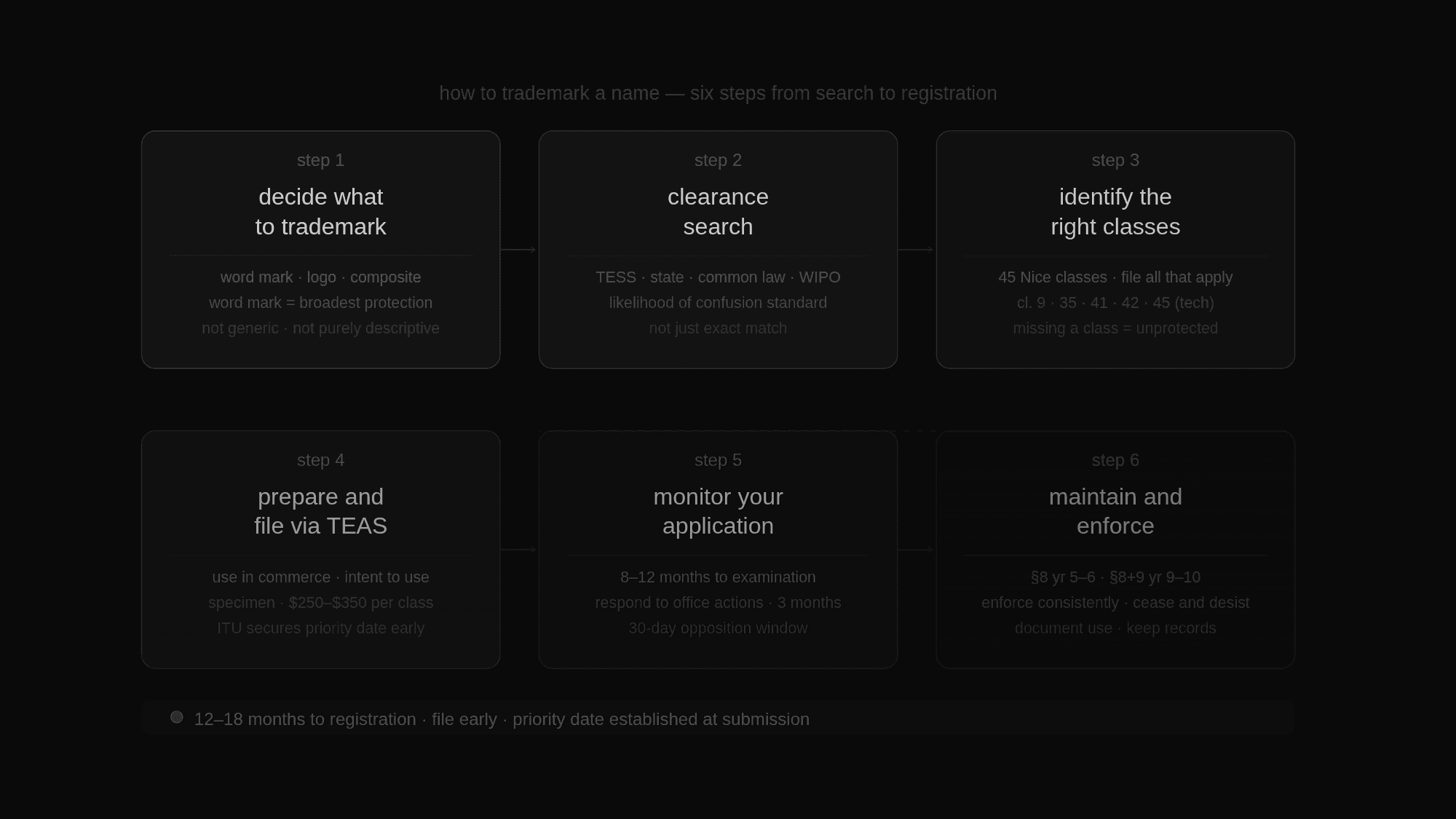
Your brand name is one of the most valuable things your business owns. It's what customers recognize, what investors evaluate, and what competitors might try to copy. Trademarking it is how you make that ownership legally enforceable.
The process involves more steps than most founders expect, and the mistakes made early — choosing a weak mark, skipping the clearance search, filing in the wrong class — are the ones that cause the most damage later. This guide walks through each step clearly so you know exactly what's involved and what to watch out for.
Step 1: Decide what you're trademarking
Before you file anything, you need to be precise about what you want to protect. A trademark application covers a specific mark — and "your brand" is not specific enough.
The three most common types of marks are:
Word marks protect the text of your name regardless of font, color, or design. A word mark for "Ana Law" would cover that phrase in any stylized form. This is typically the broadest and most valuable protection for a brand name.
Design marks (logos) protect a specific visual representation — a particular logo, icon, or stylized version of your name. Design marks are narrower than word marks because they cover only that specific image.
Composite marks protect a combination of text and design as a single unit.
For most businesses, the right starting point is a word mark for your primary brand name. If your logo is distinctive and central to your identity, a separate design mark application is worth considering. The two are not mutually exclusive.
What cannot be trademarked: generic terms that describe the product itself, purely descriptive terms without acquired distinctiveness, and names that are primarily merely a surname.
Step 2: Conduct a comprehensive trademark clearance search
This is the step most people skip and the one that causes the most problems. Filing without a proper clearance search is how you invest months and hundreds of dollars into an application that gets rejected — or worse, into building a brand that turns out to be conflicted with an existing registration.
A proper clearance search goes well beyond the USPTO database. It covers:
The USPTO's TESS (Trademark Electronic Search System) for federally registered and pending marks
State trademark registries
Common law sources: unregistered marks used in commerce that can still block your application or create infringement exposure
Domain name registries
Social media and web presence of potential conflicting users
The legal standard for conflict is "likelihood of confusion," not exact match. A mark that sounds similar, looks similar, or operates in the same commercial space as yours can block registration or expose you to a cease-and-desist even if it's not identical. This is why professional clearance searches look at phonetic similarity, visual similarity, and commercial relatedness — not just whether the exact string of letters is taken.
If the search comes back clean, you have a solid foundation to file. If it surfaces conflicts, you need to evaluate them with an attorney before proceeding.
Step 3: Identify the correct trademark classes
Trademark rights are class-specific. The USPTO uses the Nice Classification system, which divides goods and services into 45 classes. Your registration only protects you in the classes you file under.
This matters more than most founders realize. A registration in Class 41 (education and entertainment services) won't protect you in Class 9 (software) or Class 35 (business services) even if your company operates in all three. Competitors can file your mark in classes you didn't cover, and there's not much you can do about it.
Before filing, map every commercial activity your business does — and realistically plans to do — to the appropriate Nice classes. File in every class that applies. The per-class filing fee is real, but the cost of missing a class is higher.
Common classes for tech companies and startups:
Class 9: Software, apps, downloadable content
Class 35: Business services, consulting, advertising
Class 41: Educational services, online content, training
Class 42: Technology services, SaaS, legal tech, R&D
Class 45: Legal services
Step 4: Prepare and file your application
All USPTO trademark applications are filed electronically through TEAS (the Trademark Electronic Application System) at USPTO.gov.
What you'll need before you start:
A clear representation of the mark you're filing (for word marks, just the text; for design marks, a clean image file). A description of the goods and services you're filing under, written in specific language that matches USPTO standards — not "various services" or "business consulting" but precise descriptions of what you actually offer. The filing basis: either "use in commerce" (if you're already using the mark commercially) or "intent to use" (if you haven't started yet but plan to). Evidence of use if filing on a use basis: a specimen showing the mark in actual commercial activity, such as a website screenshot with the mark associated with the service and a way to purchase or contact.
Filing basis matters. An intent-to-use application lets you secure your priority date before your first sale, which is valuable for brands still in development. You'll need to submit a Statement of Use or request extensions once you begin using the mark commercially. Use-based applications require proof of use at the time of filing.
Filing fees are currently $250 to $350 per class depending on the application type. Always verify current fees on USPTO.gov before filing, as the schedule updates periodically.
Step 5: Monitor your application status
Filing is not the finish line. The USPTO examination process takes time, and what happens during that period requires your attention.
After submission, your application will be assigned to a USPTO examining attorney. They review it for procedural compliance and substantive issues — primarily whether the mark is distinctive and whether it conflicts with existing registrations. This initial review typically takes 8 to 12 months.
If your application is approved for publication, it will appear in the Official Gazette for a 30-day opposition period. Any third party who believes your mark conflicts with theirs can file an opposition. If no opposition is filed, your application proceeds to registration (for use-based applications) or to a Notice of Allowance (for intent-to-use applications).
If you receive an office action, the examining attorney has raised an issue with your application. Common office actions address: likelihood of confusion with an existing mark, a merely descriptive refusal, an improper specimen, or a description of goods and services that needs clarification. You have three months to respond (extendable to six months for a fee). Missing the deadline results in abandonment. Office action responses require careful legal analysis — this is not the stage to figure it out yourself.
Check your application status regularly in the USPTO's TSDR system, and make sure your contact information on file is current. USPTO correspondence goes to the address on record.
Step 6: Maintain and enforce your trademark after registration
A registered trademark requires active maintenance. Neglecting either step below can cost you the registration.
Meet your renewal deadlines. Between years 5 and 6 after registration, you must file a Declaration of Continued Use (Section 8). Between years 9 and 10, and every 10 years thereafter, you file a combined renewal (Sections 8 and 9). Missing these windows cancels your registration. Set calendar reminders well in advance.
Enforce your rights. A trademark you don't defend can be weakened or lost. If you discover infringement — a competitor using a confusingly similar name, a counterfeit product listing, an unauthorized social media account — respond promptly. Start with a cease-and-desist letter. If the infringement continues or the stakes are high enough, escalate to federal enforcement. Courts weigh whether trademark owners have consistently enforced their rights, so a pattern of ignoring infringement can hurt you in later disputes.
Keep records of use. Document how and where your mark is used in commerce: website screenshots, product photos, marketing materials, dated invoices. These records are your evidence in renewal filings, opposition proceedings, and infringement cases.
Frequently asked questions
How long does it take to trademark a name?
A straightforward USPTO application currently takes 12 to 18 months from filing to registration, assuming no office actions or oppositions. Intent-to-use applications can take longer depending on when use begins. Filing early means your priority date is established now, regardless of how long the examination takes.
Can I use my brand name before my trademark is registered?
Yes. You can use your name in commerce before registration, and doing so establishes common law trademark rights in the areas where you operate. However, those rights are geographically limited and harder to enforce. You can use the ™ symbol before registration; the ® symbol is only permitted after federal registration is granted.
What is an intent-to-use application?
An intent-to-use (ITU) application lets you file a trademark application before you've made your first commercial sale. You must have a bona fide intent to use the mark in commerce. Filing ITU secures your priority date immediately, which is valuable for brands still in development. You'll need to file a Statement of Use once you begin using the mark, within the deadlines the USPTO sets.
Do I need a trademark attorney to file?
You are not required to use an attorney, but the stakes are real. Clearance search errors, wrong class selection, improper specimens, and missed office action deadlines are common in self-filed applications. Given that a registration protects one of your most valuable business assets, professional guidance is almost always worth the cost.
What happens if someone opposes my trademark application?
During the 30-day publication window, third parties can file an opposition before the USPTO's Trademark Trial and Appeal Board (TTAB). If an opposition is filed, you'll need to respond and defend your application in a formal proceeding. This is where having an attorney who has litigated before the TTAB is not optional — it's essential.
What's the difference between a trademark and a business name registration?
Registering a business name with your state (as an LLC, corporation, or DBA) is a separate process from federal trademark registration. State business name registration gives you the right to operate under that name in that state. It does not give you trademark rights, does not prevent others from using the same name in commerce, and does not provide federal protection. Many founders assume their LLC registration protects their brand. It does not.
Trademarking your name is one of the highest-ROI legal steps a growing business can take. The process takes time, but every step is mechanical — and every step compounds the protection around something you've worked hard to build.
If you're ready to file or want a professional clearance search before you commit to a name, contact Ana Law to schedule a strategy session.