Article
Apr 8, 2026
US Trademark Filing for Foreign Attorneys: A Practical Guide to USPTO Requirements
Learn how foreign attorneys can file US trademark applications. Understand USPTO requirements, clearance searches, specimens, and how to avoid common filing mistakes.
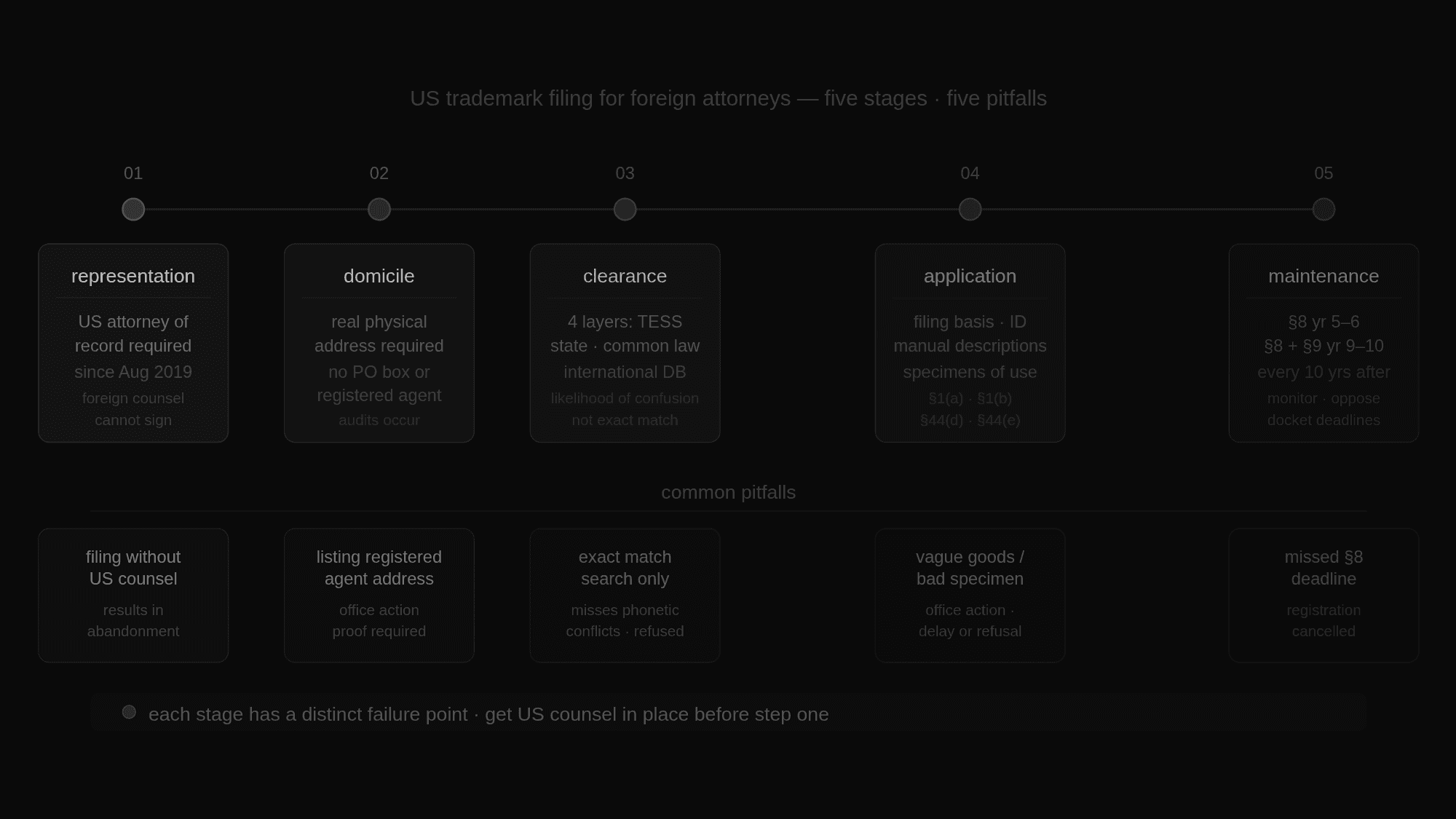
Filing a US trademark application is not complicated once you understand the rules. But for foreign attorneys coordinating filings on behalf of international clients, there are several requirements that differ meaningfully from what you may be used to in your home jurisdiction — and the consequences of getting them wrong range from office actions to outright abandonment.
This guide covers what foreign counsel needs to know: the domicile and representation requirements, how to conduct a clearance search that meets US standards, what makes a specimen acceptable, how to handle office actions, and what ongoing maintenance looks like after registration.
The representation requirement: what foreign attorneys can and cannot do
This is the threshold issue. Since August 2019, the USPTO has required that all trademark applicants domiciled outside the United States be represented by a US-licensed attorney of record. Foreign attorneys cannot serve as the attorney of record before the USPTO, regardless of their qualifications in their home jurisdiction.
What this means in practice: if you are a trademark attorney in Germany, Japan, Brazil, or anywhere else outside the US, you cannot file a USPTO application on your client's behalf without engaging a US attorney to serve as counsel of record. You can coordinate the filing, provide instructions, and manage the client relationship — but the US attorney signs the application, responds to office actions, and bears professional responsibility for the filing.
The USPTO implemented this requirement specifically to address a surge in fraudulent and non-compliant filings from foreign applicants who lacked a meaningful connection to the US legal system. Violations can result in sanctions, including suspension from practice before the USPTO for the US attorney involved.
If you are regularly handling US trademark matters for international clients, establishing a reliable referral relationship with US trademark counsel — ideally one with experience managing international portfolios — is not optional. It is the starting point.
Understanding the domicile requirement
Closely related to the representation requirement is the domicile requirement. The USPTO now requires applicants to provide a domicile address — a real physical address, not a P.O. box or registered agent address — and may audit applications to verify that the listed address is legitimate.
For individual applicants, domicile is the permanent legal residence. For entities, it is the principal place of business. Foreign companies must list their actual headquarters or primary place of business, not a US forwarding address or the address of their US counsel.
This requirement catches many international filers off guard. Applications that list a US registered agent address as the applicant's domicile are subject to office actions requiring proof of actual domicile. Prepare your clients for this before filing.
Conducting a clearance search that meets US standards
The US clearance search is broader than what most international attorneys are accustomed to. It needs to cover four distinct layers.
The USPTO trademark database — specifically TESS (Trademark Electronic Search System) — covers federally registered marks and pending applications. This is the starting point, not the complete picture.
State trademark registries matter because state registrations create enforceable common law rights in their jurisdictions that can affect federal registration and create infringement exposure even if they don't appear in the USPTO database.
Common law sources — unregistered marks used in commerce — can block registration and create infringement liability. Courts apply the likelihood of confusion standard regardless of whether the senior mark is registered. A comprehensive clearance search includes web searches, industry databases, domain registries, and marketplace searches to identify unregistered use.
International databases, including WIPO's Global Brand Database, help identify marks filed through the Madrid Protocol that may have US designation and are pending or registered in the US.
The legal standard for conflict is likelihood of confusion, not exact match. The USPTO examines marks for similarity in appearance, sound, meaning, and commercial impression — and considers whether the goods and services are related. A mark that is phonetically similar to an existing registration in a related goods category can be refused even if it looks different on paper. Any clearance search that only checks for exact or near-exact text matches is inadequate by US standards.
Preparing an application that will survive examination
Identifying the right filing basis
US trademark applications require the applicant to specify a filing basis. There are two primary options for most filers:
Use in commerce (Section 1(a)) is available when the mark is already being used in US commerce in connection with the identified goods and services. The application must include a specimen showing current use, and the declaration of use is signed under penalty of perjury.
Intent to use (Section 1(b)) allows an applicant to secure a priority date before actual use begins, provided the applicant has a bona fide intention to use the mark in US commerce. A Statement of Use must be filed once use begins, within the deadlines set by the USPTO.
Foreign applicants may also file based on a foreign registration (Section 44(e)) or a foreign application (Section 44(d)). The Section 44(d) basis allows foreign applicants to claim priority from a home-country application filed within the previous six months, which can be strategically valuable for clients who have recently filed in their home jurisdiction.
Describing goods and services with specificity
The description of goods and services is one of the most common sources of office actions in international filings. Descriptions that are acceptable in other jurisdictions are often too broad or too vague for the USPTO.
"Computer software" is not acceptable — the USPTO requires a description of what the software does. "Clothing" is not acceptable — the USPTO requires identification of specific types of clothing. "Consulting services" is not acceptable without specifying the field of consulting.
Use the USPTO's Acceptable Identification of Goods and Services Manual (the ID Manual) as your primary reference. If a description appears in the ID Manual verbatim, it will be accepted. Deviations from ID Manual language need to be carefully drafted. Overly broad descriptions will draw office actions; overly narrow descriptions may leave gaps in protection.
Getting specimens right
A specimen is evidence that the mark is being used in US commerce in connection with the goods or services identified in the application. Specimen requirements vary by goods versus services and are strictly applied.
For goods, acceptable specimens include product labels, product packaging, tags attached to the product, and screenshots of an online store showing the mark with the product and a purchase mechanism. A specimen that shows the mark in an advertisement without a purchase mechanism is not acceptable for goods.
For services, acceptable specimens include website screenshots showing the mark used in connection with the described service, advertisements for the service, and brochures or marketing materials. The mark must be used in a way that directly identifies the service, not merely as a trade name.
Common specimen failures in international filings: submitting a logo on letterhead (not acceptable for goods), submitting a homepage screenshot that doesn't show the specific service (not acceptable for services), and submitting materials that were created for the application rather than actual commercial use. The USPTO requires specimens that show use in the ordinary course of trade.
Responding to office actions
Office actions are not unusual — even well-prepared applications receive them. The key is responding correctly and on time.
Types of office actions
Non-final office actions raise issues the examiner believes may prevent registration. The applicant has three months to respond (extendable to six months for a fee). A substantive, well-organized response addressing each point raised is required.
Final office actions maintain the examiner's refusal after the initial response. Options at this stage include filing a request for reconsideration, appealing to the Trademark Trial and Appeal Board, or abandoning and refiling.
Likelihood of confusion refusals are among the most common substantive refusals. Responding requires arguing why the marks are not confusingly similar under the applicable legal framework — addressing sound, appearance, meaning, the relatedness of goods and services, and the sophistication of the relevant consumer base.
Descriptiveness refusals require either arguing that the mark is suggestive rather than descriptive, or claiming acquired distinctiveness through evidence of long use and consumer recognition.
All office action responses must be filed by the US attorney of record. Foreign counsel can draft the arguments, but the submission must come from US counsel.
Post-registration maintenance
Registration does not end the obligations. US trademark registrations have ongoing maintenance requirements that differ from many other jurisdictions.
Between years 5 and 6: A Declaration of Continued Use (Section 8) must be filed with a current specimen showing ongoing use of the mark. Failure to file results in cancellation.
Between years 9 and 10: A combined Section 8 Declaration and Section 9 Renewal application must be filed. After this, renewals are due every 10 years.
Monitoring: Registrations should be monitored against new USPTO filings, marketplace activity, and domain registrations. Opposition proceedings (filed within 30 days of publication) and cancellation proceedings are the primary mechanisms for challenging conflicting marks.
Foreign counsel coordinating ongoing US trademark portfolios for international clients should build renewal deadlines into their docketing systems and coordinate with US counsel well in advance of each filing window.
Frequently asked questions
Can a foreign attorney represent a client before the USPTO?
No. Since August 2019, applicants domiciled outside the US must be represented by a US-licensed attorney of record. Foreign counsel can coordinate the filing and manage the client relationship, but the US attorney signs all submissions and responds to office actions.
What is the domicile requirement and how does it affect foreign applicants?
The USPTO requires applicants to provide a real physical address — not a P.O. box, registered agent, or mail forwarding address — as their domicile. For companies, this is the principal place of business. Applications listing non-qualifying addresses are subject to office actions requiring proof of actual domicile.
How does the Madrid Protocol interact with direct US filing?
The Madrid Protocol allows applicants with a home-country base application or registration to file a single international application designating multiple member countries, including the US. A Madrid-designated US application undergoes the same substantive examination as a direct filing. One important distinction: Madrid applications are subject to a "central attack" — if the base application is cancelled within five years of the international registration date, the US designation falls too. Direct US filings do not have this vulnerability.
What is an intent-to-use application and when should my client use it?
An intent-to-use application allows a client to secure a US priority date before beginning commercial use of the mark in the US. This is valuable for clients who are developing a brand for the US market but haven't yet launched. The applicant must have a bona fide intent to use the mark — not merely a hope — and must file a Statement of Use within prescribed deadlines once use begins.
How long does US trademark registration take?
A straightforward application currently takes 12 to 18 months from filing to registration, assuming no office actions or oppositions. Applications that receive office actions or face third-party oppositions take longer. The priority date is established at filing, regardless of how long examination takes.
What happens if my client stops using the mark in the US?
A mark that has not been used in US commerce for three consecutive years is presumed abandoned. This presumption can be rebutted with evidence, but it shifts the burden to the trademark owner. Advise clients to maintain consistent US use of their registered marks and document that use throughout the registration period.
US trademark practice has specific requirements that don't always map cleanly onto the systems foreign attorneys are familiar with. The representation requirement, domicile rules, specimen standards, and maintenance obligations all have meaningful consequences if handled incorrectly.
Ana Law works regularly with foreign counsel to manage US trademark filings for international clients. If you have a client who needs US trademark protection and wants counsel experienced in cross-border IP matters, contact us to discuss how we can support your practice.